
1When a Tree Falls: Who Pays and What's Covered?
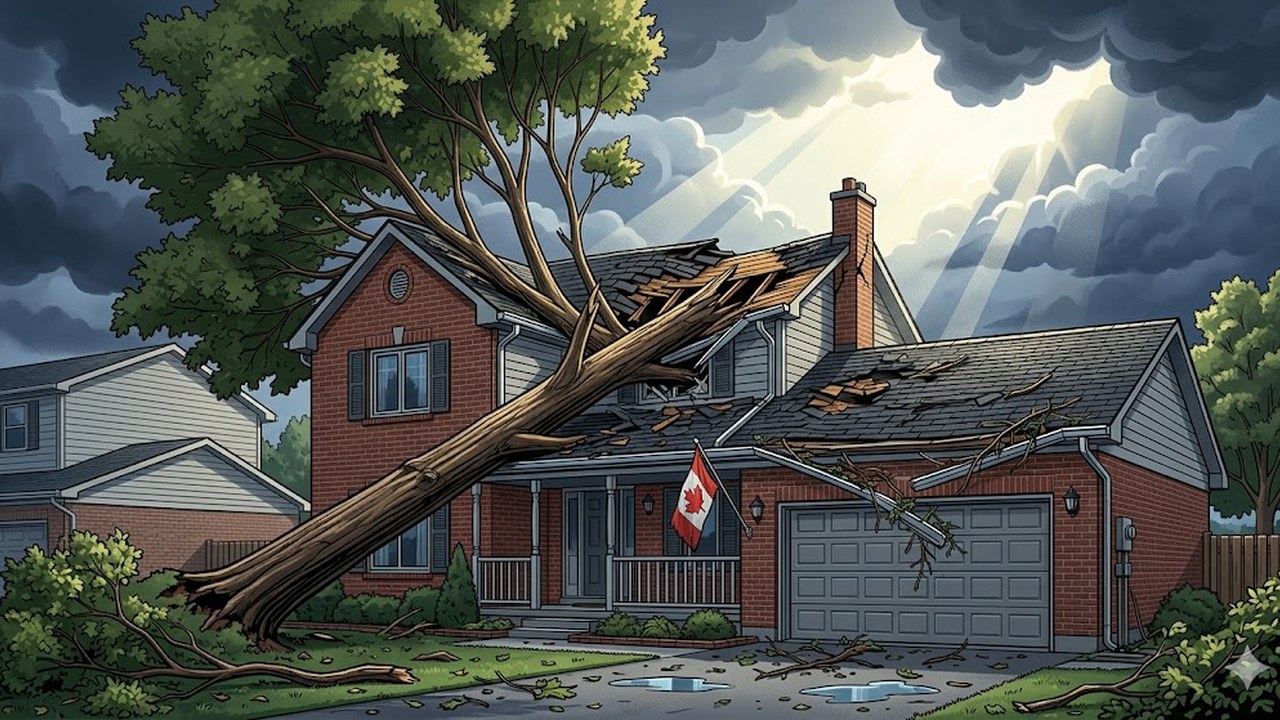
Canada has an estimated 318 billion trees — and during any given storm season, some of them are going to come down. When a tree falls on your house, garage, fence, car, or simply blocks your driveway, the insurance questions start immediately.
Tree damage is one of the most common home insurance claims in Canada, driven by windstorms, ice storms, heavy snow loads, and aging trees weakened by disease or rot. A single large tree falling on a home can cause $10,000 to $100,000+ in structural damage, plus thousands more in tree removal and debris cleanup.
The coverage rules, however, aren't as simple as "tree falls, insurance pays." Whether you're covered depends on what the tree hit, what caused it to fall, and whose tree it was. This guide breaks down every scenario Canadian homeowners need to understand.
2Scenario 1: Your Tree Falls on Your Own House
This is the most straightforward scenario — and generally the best covered.
What's Covered
If a tree on your property falls on your house due to a covered peril — such as a windstorm, ice storm, lightning, or the weight of snow — your home insurance covers:
- Structural damage to your roof, walls, windows, and other parts of the dwelling
- Interior damage — including water damage from the hole in the roof, damaged flooring, and damaged personal property
- Tree removal costs — typically $500 to $1,000 per tree, sometimes more
- Additional living expenses (ALE) — if the damage makes your home temporarily uninhabitable, your policy covers hotel stays, meals, and related costs
Covered Perils for Tree Damage
| Peril | Covered? | Notes |
|---|---|---|
| Windstorm | Yes | Most common cause of fallen trees |
| Ice storm | Yes | Heavy ice accumulation on branches |
| Lightning strike | Yes | Lightning splits or topples tree |
| Weight of snow or ice | Yes | Excessive snow load on branches |
| Hail | Yes | Can weaken limbs that then fall |
| Rot / disease / old age | Grey area | See 'Dead or Neglected Trees' section |
| Earthquake | No (without endorsement) | Requires earthquake coverage add-on |
How Much Does Tree Removal Cost?
Tree removal costs in Canada vary significantly based on size, location, and complexity:
| Tree Size | Typical Removal Cost |
|---|---|
| Small tree (under 25 feet) | $300 – $800 |
| Medium tree (25–50 feet) | $800 – $1,500 |
| Large tree (50–75 feet) | $1,500 – $3,000 |
| Very large tree (75+ feet) or hazardous location | $3,000 – $5,000+ |
Since most policies cap tree removal at $500 to $1,000 per tree, homeowners often pay out of pocket for the difference — especially for large trees. Some policies offer higher debris removal limits, so check yours.
3Scenario 2: Your Neighbour's Tree Falls on Your Property
This scenario confuses many homeowners — and sometimes leads to neighbour disputes. Here's how it works in Canada:
The General Rule
In Canada, your own home insurance pays for damage to your property caused by a neighbour's tree. It doesn't matter that the tree originated on their property. Your policy covers damage to your home from covered perils, and a tree blown over by wind is a covered peril regardless of where the tree's roots are.
Can You Sue Your Neighbour?
In most cases, no — at least not successfully. If the tree fell due to a storm and there was no negligence on your neighbour's part, they're not legally liable. The storm was an act of nature.
However, your neighbour may be liable if:
- The tree was visibly dead, diseased, or dangerously leaning and they failed to address it
- You notified them in writing about the hazardous tree and they took no action
- A certified arborist had flagged the tree as dangerous
- The tree violated municipal bylaws regarding tree maintenance
If negligence is established, your insurer may pursue subrogation — meaning they pay your claim and then seek reimbursement from your neighbour's insurer.
What About Tree Removal?
If your neighbour's tree falls on your property:
- The portion on your property is your responsibility to remove (and may be partially covered by your insurance if it hit a structure)
- The stump and roots remaining on your neighbour's property are their responsibility
- If the tree falls across a property line without hitting any structure, removal costs are typically split by arrangement between the neighbours
Protect Yourself: Document Hazardous Trees
If you notice a dead, diseased, or leaning tree on your neighbour's property that could fall on your home:
- Speak to your neighbour and express your concern
- Follow up in writing — send a letter or email documenting the hazard and requesting action
- Take dated photos of the tree's condition
- Contact your municipality — many cities have tree bylaws that can compel property owners to remove hazardous trees
- Notify your insurer — let them know about the potential risk
This documentation establishes your neighbour's awareness of the hazard, which strengthens any future negligence claim.
4Dead or Neglected Trees: When Maintenance Matters
One of the most contentious areas of tree damage claims is when the tree was already dead, visibly diseased, or clearly deteriorating before it fell.
The Insurer's Perspective
Home insurance covers sudden and accidental events. If a healthy tree is toppled by a windstorm, that's clearly sudden and accidental. But if a tree had been dead for two years and finally toppled during a moderate breeze, insurers may argue that:
- The tree's condition was a pre-existing maintenance issue
- The homeowner failed in their duty to maintain the property
- The fall was foreseeable and preventable
How Claims Are Typically Assessed
In practice, the outcome depends on the specifics:
| Situation | Likely Outcome |
|---|---|
| Healthy tree toppled by severe windstorm | Covered — clear covered peril |
| Dead tree toppled by severe windstorm | Likely covered — storm was the proximate cause |
| Dead tree falls on a calm day | Likely denied — no covered peril; maintenance issue |
| Tree with known disease falls after moderate wind | Grey area — depends on insurer and documentation |
| Arborist report recommended removal; owner didn't act | Higher chance of denial or reduced payout |
Best Practices for Tree Maintenance
- Inspect your trees annually — look for dead branches, mushroom growth at the base (a sign of internal rot), cracks in the trunk, and leaning
- Hire a certified arborist every 3 to 5 years for a professional assessment, especially for large trees near your home
- Remove dead or hazardous trees promptly — the cost of preventive removal ($300–$3,000) is almost always less than the deductible plus out-of-pocket costs from a damage claim
- Keep records of all tree maintenance, pruning, and arborist reports
- Prune overhanging branches that could fall on your roof, power lines, or neighbour's property
5Tree Damage to Fences, Sheds, Garages, and Other Structures
Your home insurance doesn't just cover your main dwelling. Other structures on your property — sometimes called Coverage B or outbuildings coverage — are also protected.
What's Covered Under Other Structures
- Fences
- Detached garages
- Garden sheds and storage buildings
- Decks and patios (if detached from the house)
- Gazebos and pergolas
- Pools and pool equipment enclosures
Coverage Limits
Other structures coverage is typically set at 10% of your dwelling coverage. For a home insured at $400,000, that means $40,000 for all other structures combined. This is usually adequate for most properties, but if you have a high-value detached garage, workshop, or pool house, you may want to increase this limit.
Common Tree Damage Scenarios for Other Structures
| Scenario | Covered? | Which Coverage Responds |
|---|---|---|
| Tree falls on fence during windstorm | Yes | Other structures (Coverage B) |
| Tree falls on detached garage | Yes | Other structures (Coverage B) |
| Tree falls on garden shed | Yes | Other structures (Coverage B) |
| Tree damages deck attached to house | Yes | Dwelling (Coverage A) |
| Tree falls on landscaping only | Limited | See landscaping section below |
Landscaping Coverage
If a tree falls and damages your landscaping — including other trees, shrubs, plants, and lawn — coverage is limited. Most policies provide:
- 5% of dwelling coverage for all landscaping, with a maximum of $500 to $1,000 per item (per tree, shrub, or plant)
- Coverage is restricted to specific perils — typically fire, lightning, explosion, riot, aircraft, and vehicle damage. Notably, wind and ice storms are often excluded from landscaping coverage
- The coverage replaces the value of the plants themselves, not the cost of mature replanting
This means a 50-year-old oak tree destroyed by a storm might yield only $500 in landscaping coverage, even though a comparable replacement could cost several thousand dollars.
6A Tree Fell on Your Car: Which Insurance Covers It?
This is a common point of confusion. When a tree falls on your vehicle, your auto insurance handles it — not your home insurance.
How Auto Insurance Covers Tree Damage
The specific auto coverage that applies is comprehensive coverage (also known as Section D — All Perils or Specified Perils in some provinces). This coverage pays for damage to your vehicle from events other than collisions, including:
- Falling trees and branches
- Windstorm and hail damage
- Flooding
- Vandalism
Important Notes
- You need comprehensive coverage: If you only carry basic liability auto insurance (the legal minimum), damage to your vehicle from a fallen tree is not covered. You pay for repairs or replacement out of pocket.
- Your deductible applies: Comprehensive deductibles in Canada typically range from $300 to $1,000. If the tree caused $2,000 in damage and your deductible is $500, you receive $1,500.
- Location doesn't matter: Whether the tree falls on your car in your driveway, at work, or on a public road, the comprehensive coverage applies the same way.
- Rental car coverage: If your vehicle needs extended repairs, your auto policy's loss-of-use coverage (if you have it) or a rental car endorsement covers a replacement vehicle.
What If the Tree Was From Your Neighbour's Property?
Same rule as with home damage — your own auto insurance pays for the damage to your car. Your insurer may pursue subrogation against your neighbour if negligence is established (e.g., a dead tree your neighbour was warned about).
7Understanding Debris Removal Limits
Tree removal after a storm is often more expensive than homeowners expect — and insurance coverage has specific limits that may not cover the full cost.
How Debris Removal Coverage Works
Most Canadian home insurance policies include debris removal coverage as part of your dwelling or other structures coverage. Here's how it typically works:
- Tree hits a structure: Removal costs are covered as part of the claim, usually capped at $500 to $1,000 per tree
- Tree falls on your lawn (no structure damage): Removal costs are generally your responsibility — the tree didn't damage an insured structure, so there's no covered claim
- Multiple trees down: After a major storm, you may have several trees down. The per-tree cap applies to each one individually
- Stump removal: Most policies do not cover stump removal or grinding — only removing the fallen trunk and branches
When Debris Removal Exceeds Your Limits
After a severe ice storm or windstorm, tree removal companies are in high demand, and prices surge. In these situations:
- Emergency removal (immediate hazard to a structure or power line) costs more than scheduled removal
- Large trees in tight spaces (close to buildings, fences, or power lines) require cranes or specialized equipment, driving costs to $3,000–$5,000+ per tree
- If your policy's debris removal cap is $1,000 and the actual cost is $4,000, you pay the $3,000 difference
How to Prepare
- Review your policy's debris removal limit — some insurers offer higher limits for an additional premium
- Ask about a debris removal endorsement that provides additional coverage beyond the standard cap
- After a storm, get multiple quotes for tree removal before hiring — prices vary widely, and the urgency premium can be substantial
- Prioritize hazardous removals (trees leaning on the house, blocking access, or tangled in power lines) and defer non-urgent removals until demand subsides
8How to File a Tree Damage Claim
Tree damage claims follow the same general process as other home insurance claims, but there are a few tree-specific considerations:
Step-by-Step Process
- Ensure safety first. Stay away from downed power lines. If a tree has damaged power lines, call your utility company and 911 immediately. Do not attempt to remove the tree yourself.
- Document the damage. Take extensive photos and videos of the fallen tree, the damage to your home and other structures, and the surrounding area. Include wide shots showing the tree's original location (stump) and where it landed.
- Prevent further damage. Cover any openings in your roof or walls with tarps to prevent water damage. If the tree is still partially attached and could cause additional damage, note this when you call your insurer.
- Contact your insurer promptly. Report the claim and provide your documentation. Ask specifically about debris removal limits and any deadlines for completing repairs.
- Get repair and removal estimates. Obtain at least two written quotes for tree removal and two for structural repairs. Your insurer may have preferred contractors, but you generally have the right to choose your own.
- Keep all receipts. Emergency tarps, temporary repairs, hotel stays (if needed), and any other expenses related to the tree damage should be documented and submitted to your insurer.
Tips for a Stronger Claim
- If the tree was healthy before the storm, note this — it reinforces that the damage was caused by a covered peril rather than maintenance neglect
- If you have records of tree maintenance, pruning, or arborist inspections, provide them to the adjuster
- Ask your insurer whether tree removal costs are subject to your deductible or covered separately
- If the tree damaged multiple structures (house + fence + shed), each structure may be a separate claim component with its own coverage applying
9Final Thoughts: Trees and Insurance in Canada
Tree damage is one of the most common — and most confusing — areas of home insurance. The rules aren't always intuitive, especially when it comes to neighbour trees, debris removal limits, and the line between storm damage and maintenance neglect.
Here are the key takeaways for Canadian homeowners:
- Your insurance covers tree damage from covered perils like windstorms, ice storms, and lightning — but debris removal has caps
- Your neighbour's tree, your insurance claim — damage to your property is covered by your policy, regardless of where the tree grew
- Maintain your trees — dead, diseased, or leaning trees are a liability that can lead to denied claims and neighbour disputes
- Trees on cars = auto insurance — you need comprehensive coverage on your auto policy
- Landscaping coverage is minimal — don't expect your policy to replace mature trees at full value
- Document everything — the condition of your trees before a storm, the damage after, and all communications with your insurer
Taking preventive action — regular tree inspections, prompt removal of hazardous trees, and understanding your policy's specific limits — is always less expensive than dealing with the aftermath of a fallen tree.
Frequently Asked Questions
Yes, but with limits. If a tree falls on your house, garage, or other insured structure due to a covered peril like a windstorm, your home insurance typically covers the tree removal as part of the claim. However, most policies cap tree debris removal at $500 to $1,000 per tree. If the tree falls on your lawn but doesn't hit any structure, removal costs are generally your responsibility.
In Canada, your own home insurance pays for the damage to your property — regardless of whose tree caused it. Your insurer may then pursue subrogation (reimbursement) against your neighbour's insurer if the neighbour was negligent, such as failing to remove a visibly dead or dangerous tree after being warned.
Yes. Fences are covered under the 'other structures' section of your home insurance policy (also called Coverage B or outbuildings coverage). If a tree falls on your fence due to a covered peril, the repair or replacement cost is covered, subject to your deductible. Your other structures coverage is typically 10% of your dwelling coverage.
This is a grey area. If the tree was clearly dead, diseased, or leaning dangerously and you failed to have it removed, your insurer may argue negligence and reduce or deny the claim. However, if the dead tree fell during a severe windstorm, the storm may still be considered the proximate cause and the claim may be approved. Documentation of the tree's condition and any maintenance efforts is important.
Your auto insurance covers this, not your home insurance. Specifically, the comprehensive (Section D) coverage on your auto policy pays for damage to your vehicle from a fallen tree. If you only carry basic liability auto coverage without comprehensive, the damage to your car is not covered.
Not sure if your policy covers tree damage? Get a home insurance quote with clear coverage details in 90 seconds.
Get Your Quote