
1Why Most Canadians Are Underinsured Without Knowing It
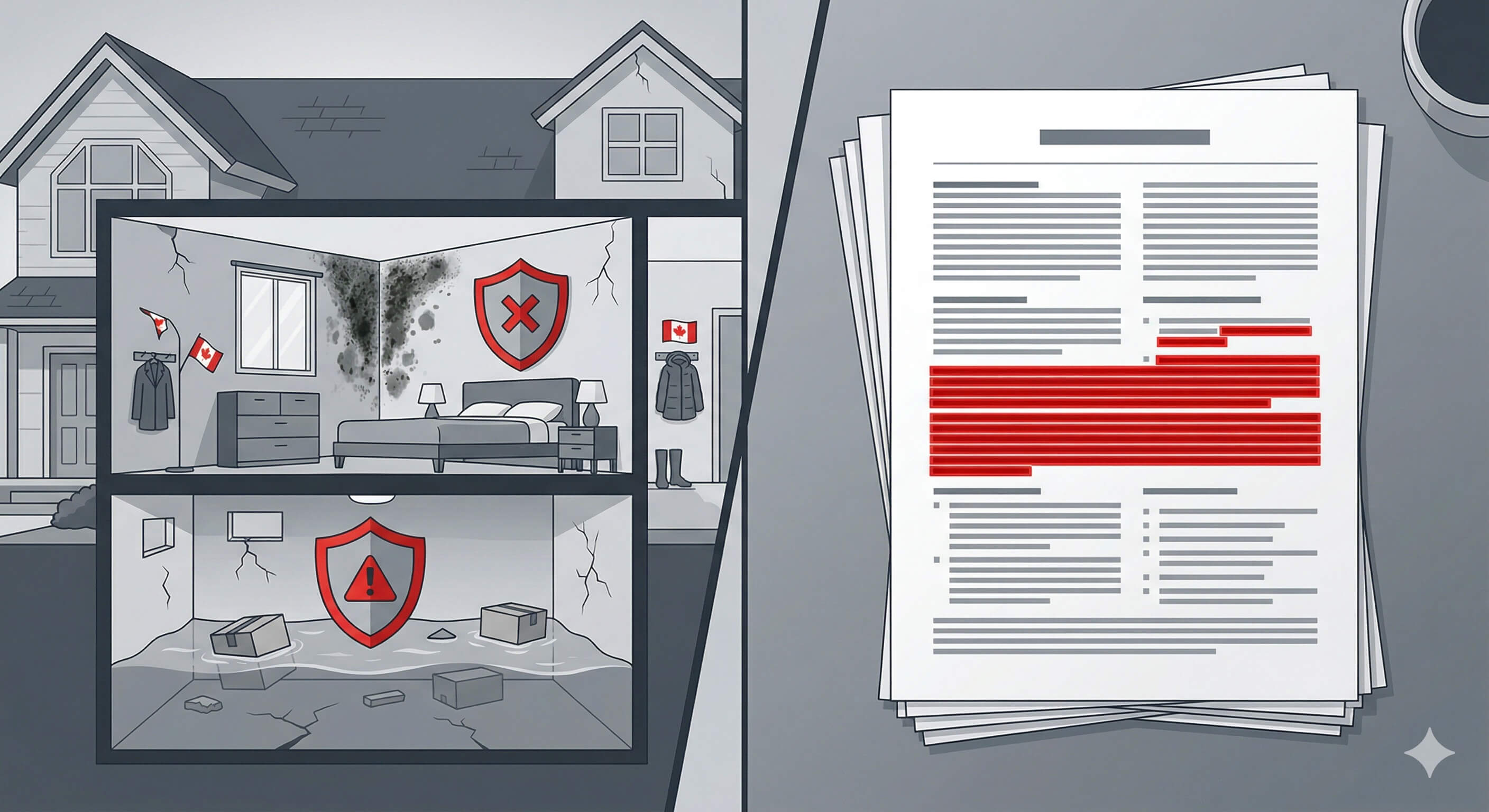
Here's a scenario that plays out across Canada every year: a homeowner experiences damage to their property, files an insurance claim, and discovers — too late — that their home insurance policy doesn't cover it.
The truth is, most people buy home insurance and never actually read what's excluded. They assume "covered" means "covered for everything." It doesn't.
In this guide, we'll walk through the 10 most common home insurance exclusions in Canada — the ones that catch people off guard when it matters most. Understanding these gaps now could save you thousands of dollars and a significant amount of stress later.
21. Overland Flooding
This is the single most surprising exclusion for Canadian homeowners. Standard home insurance does not cover overland flooding — water that enters your home from swollen rivers, heavy rainfall runoff, or rapid snowmelt.
Given that flooding is the most costly natural disaster in Canada, this is a dangerous gap. The Insurance Bureau of Canada reports that insured losses from water damage have more than doubled over the past two decades.
What you can do: Most Canadian insurers now offer an optional overland flood endorsement. The cost varies based on your location and proximity to water, but it's typically $100–$300 per year — a small price for protection against a loss that can easily reach $50,000+.
32. Sewer and Drain Backup
If sewage backs up into your basement through floor drains, toilets, or sinks, your standard home insurance policy won't pay for the damage or cleanup. This is separate from overland flooding and requires its own endorsement.
Sewer backup is especially common in older Canadian cities where aging municipal infrastructure can't handle heavy rainfall. Cleanup costs typically range from $5,000 to $25,000+, depending on the extent of contamination.
What you can do: Add a sewer backup endorsement to your policy. It's one of the most affordable add-ons available and is strongly recommended for any home with a basement. Also consider installing a backwater valve — many municipalities offer rebates for installation.
43. Earthquake Damage
Canada has significant seismic zones — particularly in British Columbia, the Ottawa-Gatineau region, and parts of Quebec. Yet standard home insurance excludes earthquake damage entirely.
An earthquake can cause structural cracking, foundation damage, chimney collapse, and even total loss. Without the endorsement, you're responsible for all repair costs out of pocket.
What you can do: If you live in a seismically active area, add earthquake coverage to your policy. Premiums in BC are higher (given the risk), but the protection is essential. In lower-risk regions, the endorsement is surprisingly affordable.
54. Gradual Damage and Wear-and-Tear
Home insurance covers sudden and accidental events — not slow deterioration. This means the following are excluded:
- A roof that leaks because shingles are 25 years old
- A foundation that cracks over time due to settling
- Pipes that corrode slowly and eventually burst
- Paint peeling, wood rotting, or siding warping from age
Insurers expect homeowners to maintain their property in reasonable condition. If they determine that damage resulted from deferred maintenance rather than a sudden event, your claim will be denied.
What you can do: Stay on top of regular home maintenance. Replace aging systems before they fail. Keep records of maintenance work — they can support your claim if damage does occur from a covered peril.
65. Mould
Mould that develops gradually from humidity, poor ventilation, or slow leaks is not covered by standard home insurance in Canada. Mould remediation can cost anywhere from $1,500 to $30,000 depending on the extent of the problem.
There's one exception: if mould results directly from a sudden, covered event — like a burst pipe or an insured fire where water was used to extinguish flames — the mould cleanup may be included as part of that specific claim.
What you can do: Control indoor humidity (keep it below 50%), ensure proper ventilation in bathrooms and kitchens, fix any leaks immediately, and inspect basements and crawl spaces regularly.
76. Home-Based Business Equipment and Liability
If you run a business from home — even a small online shop or freelancing operation — your standard home insurance policy likely won't cover:
- Business equipment (computers, inventory, specialized tools)
- Liability if a client visits your home and is injured
- Lost income if a covered peril shuts down your business operations
With more Canadians working from home than ever, this exclusion affects a growing number of people.
What you can do: Ask your insurer about a home-based business endorsement, or consider a separate commercial insurance policy if your business involves significant inventory, client visits, or revenue. Learn more about commercial insurance options.
87. High-Value Items Beyond Policy Limits
Standard home insurance includes personal property coverage, but it places sub-limits on certain categories of valuable items:
| Item Category | Typical Sub-Limit |
|---|---|
| Jewelry & watches | $3,000 – $6,000 |
| Art & collectibles | $2,000 – $5,000 |
| Firearms | $2,000 – $3,000 |
| Cash & securities | $200 – $500 |
| Bicycles | $1,000 – $2,000 |
| Wine collections | $1,000 – $2,000 |
If your engagement ring is worth $15,000 and your policy sub-limit for jewelry is $5,000, you'll only receive $5,000 — regardless of what you paid.
What you can do: Add a scheduled items endorsement (also called a rider or floater) to specifically list and insure high-value items at their appraised value. Get professional appraisals and keep them updated every 3–5 years.
98. Pest and Animal Damage
Damage caused by insects, rodents, raccoons, birds, or other pests is not covered by standard home insurance policies. This includes:
- Termite damage to structural wood
- Mice or squirrels chewing through electrical wiring
- Raccoons tearing through roof shingles or soffits
- Bird nests blocking ventilation systems
Pest damage is considered a maintenance issue — something homeowners are expected to prevent and address.
What you can do: Seal entry points around your home, trim tree branches away from your roof, store food securely, and schedule regular pest inspections. Address any signs of infestation immediately before damage escalates.
109. Intentional Damage or Illegal Activity
This one might seem obvious, but it's worth stating: home insurance will not cover damage that you or a household member intentionally causes. It also won't cover losses connected to illegal activity conducted on the property.
Less obvious scenarios that fall under this exclusion:
- A tenant operating an illegal business that causes property damage
- A household member's vandalism during a domestic dispute
- Damage resulting from illegal modifications to your home
What you can do: If you're a landlord, ensure your tenants understand the lease terms. If you're making modifications to your home, always obtain proper permits.
1110. Damage to a Vacant or Unoccupied Home
If your home is left unoccupied for more than 30 consecutive days (the exact period varies by insurer), most home insurance policies in Canada will significantly restrict or void coverage. Common scenarios:
- Snowbirds who spend winter months in Florida or Arizona
- Homeowners travelling for extended work assignments
- Properties awaiting sale or renovation
- Inherited homes that haven't been occupied
Insurers consider vacant homes higher risk because there's no one present to detect and mitigate issues like burst pipes, break-ins, or fire.
What you can do: Notify your insurer before any extended absence. Ask about vacancy permits or special endorsements. Arrange for someone to check on your home regularly (most insurers want weekly checks). Install smart home monitoring devices for water leaks, temperature, and security.
12How to Protect Yourself Against Coverage Gaps
Now that you know what standard home insurance doesn't cover, here's a simple action plan:
- Read your policy declarations page. This summary document lists your coverages, limits, deductibles, and exclusions. It's only a few pages and gives you the full picture.
- Ask about endorsements. Most of the exclusions listed above can be covered by adding optional endorsements to your policy. The most important ones for most Canadians: overland flood, sewer backup, and scheduled items.
- Document your belongings. Create a home inventory with photos, receipts, and estimated values. Store it in the cloud so it's accessible even if your home is damaged.
- Review annually. Your coverage needs change as your home's value changes, as you acquire new possessions, and as your life circumstances evolve.
- Compare quotes. Different insurers offer different endorsements at different prices. Getting a home insurance quote from multiple providers ensures you get the right coverage at the best rate.
13Final Thoughts
Your home insurance policy is one of the most important financial products you own — but only if you understand what it actually covers. The 10 exclusions in this guide aren't obscure fine print; they're real gaps that affect thousands of Canadian homeowners every year.
The good news is that most of these gaps can be closed with affordable endorsements. The key is knowing about them before you need to file a claim, not after.
Take 10 minutes today to review your policy. It could be the most valuable 10 minutes you spend all year.
Powered by Bluecouch
Make Sure Your Home Is Actually Covered — Check Your Options Now
- Easily add endorsements like overland flood, sewer backup, and earthquake coverage
- Bluecouch shows you exactly what each policy covers before you buy
- Compare multiple providers side by side — no surprises at claim time
- Get a complete, customized home insurance quote in under 10 minutes
Frequently Asked Questions
Standard home insurance policies in Canada do NOT cover overland flooding — meaning water that enters your home from rising rivers, heavy rainfall runoff, or spring snowmelt. However, most insurers now offer optional overland flood endorsements that you can add to your policy for an additional premium. Sewer backup is also excluded by default but can be added separately.
Generally, no. Home insurance does not cover mould that develops gradually due to poor ventilation, deferred maintenance, or slow leaks. However, if mould results directly from a sudden, covered event — like a burst pipe — the mould remediation may be included as part of that claim. Prevention and regular maintenance are your best defence.
Standard home insurance policies place sub-limits on high-value items. Jewelry is typically capped at $3,000–$6,000, and art or collectibles may have similar limits. To fully protect expensive items, you need to add a scheduled items endorsement (also called a rider or floater) that specifically lists and values each item.
No. Home insurance is designed to cover sudden and accidental events, not gradual deterioration. If your roof leaks because shingles haven't been replaced in 30 years, or your basement floods because of a cracked foundation you never repaired, those claims will be denied. Insurers expect homeowners to maintain their property in reasonable condition.
Contact your insurance provider or broker immediately and ask about endorsements or riders that can fill the gap. Common add-ons include overland flood coverage, sewer backup, earthquake insurance, and scheduled items for valuables. It's always better to discover and fix coverage gaps before you need to make a claim.
Not sure what your policy covers? Get a transparent home insurance quote in 90 seconds.
Get Your Quote