

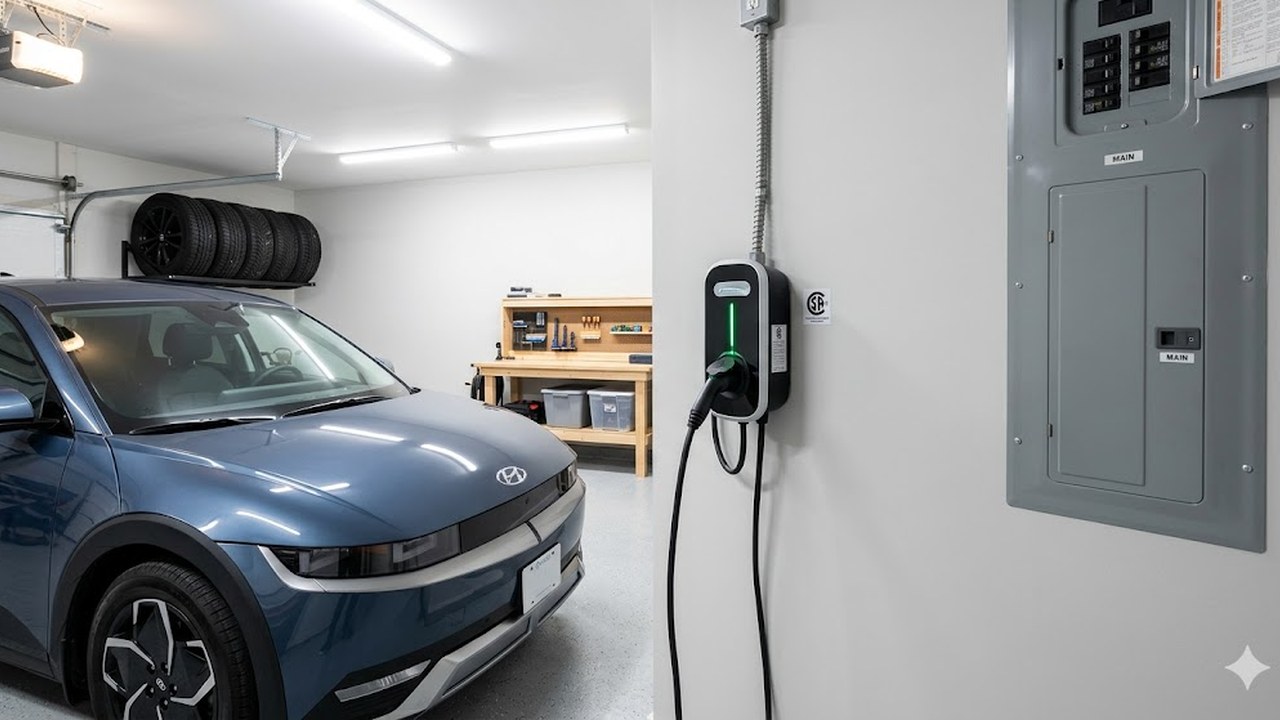
1The EV Revolution Is Coming Home — Is Your Insurance Ready?
Electric vehicle adoption in Canada has been accelerating rapidly. According to Statistics Canada and Transport Canada, EV registrations surpassed 470,000 cumulative zero-emission vehicles on Canadian roads by the end of 2025, with battery electric vehicles (BEVs) and plug-in hybrids (PHEVs) accounting for over 12% of all new vehicle sales nationally. In British Columbia and Quebec — the two provinces with the strongest EV incentive programs — EV market share exceeded 25% and 18% respectively.
With this surge in EV ownership comes a parallel trend: home EV charging station installations. Over 80% of EV charging in Canada happens at home, and the number of residential Level 2 charger installations has grown by approximately 40% year-over-year since 2023. The federal government's Zero Emission Vehicle Infrastructure Program (ZEVIP) and various provincial rebates have further accelerated adoption.
But here's what many new EV owners don't consider: installing a charging station at home affects your home insurance. It changes your home's electrical profile, introduces new equipment that could malfunction, and creates liability scenarios that didn't exist before. Most home insurance policies will cover a properly installed charger, but there are important nuances, notification requirements, and potential gaps you need to understand.
2Level 1 vs Level 2 Chargers: Understanding the Risk Difference
Not all EV chargers are created equal, and the type of charger you install at home has a direct impact on both the risk to your property and your insurance considerations.
| Feature | Level 1 Charger | Level 2 Charger |
|---|---|---|
| Voltage | 120V (standard outlet) | 240V (dedicated circuit) |
| Amperage | 12–16 amps | 30–50 amps |
| Charging speed | 5–8 km of range per hour | 30–50 km of range per hour |
| Installation required? | No — plugs into existing outlet | Yes — requires dedicated circuit and often a panel upgrade |
| Permit required? | No | Yes (in most provinces) |
| Typical cost (equipment + install) | $300–$600 (usually included with vehicle) | $1,500–$3,500 |
| Insurance notification needed? | Not typically | Yes — recommended |
Level 1: Minimal Risk
Level 1 chargers use a standard 120V household outlet — the same outlet you'd plug a toaster or lamp into. They draw relatively low power (12–16 amps) and require no installation or electrical modifications. From an insurance perspective, a Level 1 charger is essentially a household appliance and poses no additional risk beyond what's already covered by your home insurance policy.
Level 2: The Standard for Home Charging
Level 2 chargers are the most popular choice for Canadian EV owners because they charge roughly 5 to 7 times faster than Level 1. However, they require a 240V dedicated circuit — the same voltage used by your electric dryer or oven — and often require a panel upgrade to accommodate the additional electrical load. This is where insurance implications begin:
- Higher electrical load: A 48-amp Level 2 charger draws significant power, potentially stressing older wiring
- New dedicated circuit: Professional installation involves running new wiring from your panel to the charger location
- Panel upgrade: Many Canadian homes — especially those built before 2000 — have 100-amp or 125-amp panels that may need upgrading to 200 amps to safely support a Level 2 charger alongside existing loads
- Outdoor installation: Many chargers are installed in garages or on exterior walls, exposing them to weather and requiring weatherproof enclosures
3Electrical Fire Risk: What the Data Shows
One of the primary concerns insurers have about EV home charging is electrical fire risk. While the risk is statistically low for properly installed systems, it's not zero — and improper installations significantly increase the danger.
How EV Charger Fires Happen
The most common causes of EV charger-related fires at homes include:
- Overloaded circuits: Installing a high-draw charger on a circuit that wasn't designed to handle the continuous load
- Faulty wiring connections: Loose or improperly made connections at the panel, junction box, or charger generate heat that can ignite surrounding materials
- Non-certified equipment: Using chargers that don't carry CSA, ULC, or cUL certification marks — these haven't been tested to Canadian safety standards
- DIY installation: Homeowners attempting to install 240V circuits themselves without proper knowledge or tools
- Aging electrical panels: Older panels — particularly Federal Pacific (FPE) Stab-Lok and Zinsco panels, which are known fire hazards — may not safely handle the additional load
- Extension cord use: Using extension cords with Level 1 chargers (especially non-heavy-duty cords) is a common fire starter
Canadian Fire Statistics
While Canada doesn't yet maintain a separate statistical category for EV charger fires, the Electrical Safety Authority (ESA) in Ontario has reported a growing number of incidents related to EV charging equipment. In the United States, the National Fire Protection Association (NFPA) has documented that the majority of EV-charging-related fires occurred in homes with improper or unpermitted installations. Canadian fire marshals expect similar patterns as EV adoption grows.
The Key Takeaway for Insurance
Insurers are not anti-EV charger. They are anti-improperly installed EV charger. A charger installed by a licensed electrician, with proper permits, using certified equipment, and inspected by the relevant authority is a minimal risk. A DIY installation on an overloaded panel with no permit is a claim waiting to happen — and one your insurer may not pay.
4Does Your Home Insurance Cover EV Charger Damage and Liability?
Let's break down exactly how your home insurance interacts with your EV charging station across different scenarios:
Damage to the Charger Itself
A permanently installed Level 2 charger is generally considered part of your home's dwelling coverage (Coverage A) — just like your furnace, water heater, or built-in appliances. If it's damaged by a covered peril (fire, lightning, vandalism, falling objects, etc.), your home insurance should cover repair or replacement costs, minus your deductible.
A portable Level 1 charger, on the other hand, would fall under your personal property/contents coverage (Coverage C) since it's not permanently attached to the home.
Damage Caused by the Charger
If your EV charger malfunctions and causes damage to your home — for example, an electrical fire that damages your garage — your home insurance's dwelling and contents coverage should respond, provided the charger was properly installed. If the charger was installed without permits or by an unlicensed person, your insurer has grounds to deny the claim.
Liability Scenarios
Your home insurance includes personal liability coverage (typically $1 million to $2 million) that can come into play in several EV charger-related scenarios:
| Scenario | Covered by Home Insurance Liability? | Notes |
|---|---|---|
| Visitor trips over charging cable and is injured | Yes | Standard premises liability |
| Visitor's EV is damaged by your faulty charger | Likely yes | Subject to investigation of charger condition |
| Charger causes a fire that spreads to neighbour's property | Yes | Your liability coverage protects you against third-party claims |
| Electrical surge through charger damages visitor's EV battery | Likely yes | May involve charger manufacturer's product liability as well |
| Child is shocked by exposed/damaged charger wiring | Yes | You may also face code violation issues if installation was improper |
Your Own Vehicle
Important distinction: damage to your own EV while it's charging at home is covered by your auto insurance policy, not your home insurance. If a power surge through your charger damages your vehicle's battery or charging system, you'd file a claim under the comprehensive coverage on your auto policy.
5Notifying Your Insurer: When and How
You should notify your home insurer when you install a Level 2 EV charger. Here's what to communicate and why it matters:
Why You Should Notify
While not all insurers explicitly require notification for EV charger installation, there are compelling reasons to do so:
- Material change in risk: Adding a 240V circuit and new electrical equipment changes your home's risk profile. Disclosing proactively ensures your coverage remains valid.
- Replacement cost accuracy: Your dwelling coverage needs to reflect the value of all permanently installed fixtures, including the charger (which can cost $1,500–$3,500 installed).
- Avoiding claim disputes: If you file a claim related to electrical issues and your insurer discovers an undisclosed charger installation, it could complicate your claim.
What to Tell Your Insurer
When you call your insurer or broker, provide:
- Charger details: Make, model, amperage rating, and whether it's hardwired or plug-in
- Installation details: Name of the licensed electrician or contractor, and whether a panel upgrade was performed
- Permit number: The electrical permit number issued by your municipality
- Inspection confirmation: Proof that the installation was inspected and approved (e.g., ESA certificate in Ontario)
- Location: Whether the charger is in a garage, carport, driveway, or exterior wall
What to Expect from Your Insurer
Most Canadian insurers will simply note the installation on your file with no premium change. Some may:
- Ask for a copy of the electrical permit and inspection certificate
- Adjust your dwelling replacement cost estimate upward slightly
- Apply a small premium adjustment (typically 1–3%) to reflect the additional equipment
- Confirm that your current electrical panel is adequate and in good condition
If your home has known electrical issues — such as an aluminum wiring system, Federal Pacific panel, or knob-and-tube wiring — your insurer may require those issues to be resolved before they'll accept the additional electrical load of an EV charger without applying an exclusion or surcharge.
6Installation Requirements Across Canada
Proper installation isn't just about insurance — it's a legal and safety requirement in every Canadian province. Here's what you need to know:
National and Provincial Electrical Codes
All EV charger installations in Canada must comply with the Canadian Electrical Code (CEC), which is adopted (with provincial amendments) by every province and territory. Key CEC requirements for EV charging include:
- Dedicated circuit: Level 2 chargers require a dedicated branch circuit — no sharing with other loads
- Properly rated wire: Wiring must be rated for 125% of the charger's maximum continuous current (e.g., a 40-amp charger requires wiring rated for at least 50 amps)
- GFCI protection: Ground-fault circuit interrupter protection is required for EV charging circuits in many jurisdictions
- Weatherproof enclosure: Outdoor installations require NEMA-rated weatherproof enclosures and connectors
Province-Specific Requirements
| Province | Permit Required? | Inspection Authority | Key Notes |
|---|---|---|---|
| Ontario | Yes | Electrical Safety Authority (ESA) | Must be installed by a Licensed Electrical Contractor (LEC); ESA inspection mandatory |
| British Columbia | Yes | Technical Safety BC | Permit from local municipality; inspection by Technical Safety BC |
| Alberta | Yes | Municipal or Safety Codes Council | Permit from municipality; inspection required before use |
| Quebec | Yes | Régie du bâtiment du Québec (RBQ) | Must be installed by licensed master electrician |
| Manitoba | Yes | Manitoba Hydro / Municipal | Permit and inspection required |
| Saskatchewan | Yes | SaskPower / Municipal | Permit required; inspection recommended |
| Nova Scotia | Yes | Nova Scotia Power / Municipal | Permit required for 240V installations |
Rebates and Incentives
Several programs help offset installation costs — and the documentation from these programs can also serve as proof of proper installation for your insurer:
- Natural Resources Canada ZEVIP: Up to $5,000 for workplace and multi-unit residential charger installations
- Quebec: Roulez vert program offers up to $600 for home charger installation
- British Columbia: CleanBC Go Electric program provides up to $350 for Level 2 home charger installation
- Various utility rebates: Local utilities like BC Hydro, Hydro-Québec, and Toronto Hydro may offer additional rebates
8Charge Confidently with the Right Coverage
Installing an EV charging station at home is a smart, practical decision — and for the vast majority of Canadian homeowners, it does not require purchasing additional insurance coverage. Your existing home insurance policy will cover your charger as part of your dwelling, and your personal liability coverage extends to charging-related incidents involving visitors.
The key to maintaining seamless coverage is doing things properly:
- Hire a licensed electrician — never attempt a Level 2 installation yourself
- Get the required permits and inspections in your province
- Use CSA-certified equipment from reputable manufacturers
- Notify your insurer about the installation and provide documentation
- Keep installation records — permits, inspection certificates, and receipts
As EV adoption continues to grow across Canada — and the federal government's 2035 ZEV mandate approaches — home charging infrastructure will become as common as central air conditioning. Getting the installation and insurance right from the start ensures your home is protected as you make the transition to electric driving.
Frequently Asked Questions
In most cases, yes — a properly installed EV charging station is considered a permanently attached fixture of your home and is covered under the dwelling or structures portion of your home insurance policy. This means if your charger is damaged by a covered peril such as fire, lightning, vandalism, or a falling tree, your policy should pay for repair or replacement. However, you should notify your insurer about the installation, as it represents a change to your home's electrical system and overall risk profile.
For a professionally installed Level 2 charger with proper permits and ESA inspection (in Ontario), most Canadian insurers will not increase your premiums. Some may apply a modest increase of 1% to 3% to account for the added electrical load and equipment value. However, if the installation is done without permits, by an unlicensed electrician, or involves modifications that don't meet code, your insurer could increase your premium significantly or add exclusions. Always get proper installation documentation.
If a properly installed and maintained EV charger causes a fire, your home insurance should cover the resulting damage under your dwelling and contents coverage. However, if the fire was caused by an improperly installed charger — for example, one installed without a permit, by an unlicensed person, or using components that don't meet Canadian electrical code — your insurer could deny the claim on the grounds that you failed to maintain safe conditions. This is why professional installation with proper permits is critical.
Potentially, yes. If a visitor's electric vehicle is damaged while charging at your home due to a fault with your charging equipment — such as an electrical surge, faulty wiring, or equipment malfunction — you could be held liable. Your home insurance personal liability coverage would typically respond to such a claim, subject to your policy limits. If the damage was caused by a defect in the charger itself, the charger manufacturer's product liability insurance may also be involved.
Yes, in most Canadian jurisdictions you need an electrical permit to install a Level 2 EV charger (240V). In Ontario, the installation must be performed by a Licensed Electrical Contractor (LEC) and inspected by the Electrical Safety Authority (ESA). British Columbia, Alberta, and other provinces have similar requirements through their respective electrical safety authorities. Level 1 chargers (120V plug-in) generally do not require permits as they use standard household outlets. Skipping permits can void your insurance coverage.
Installing an EV charger? Make sure your home coverage keeps up. Get a quote with EV-ready protection.
Get Your Quote