

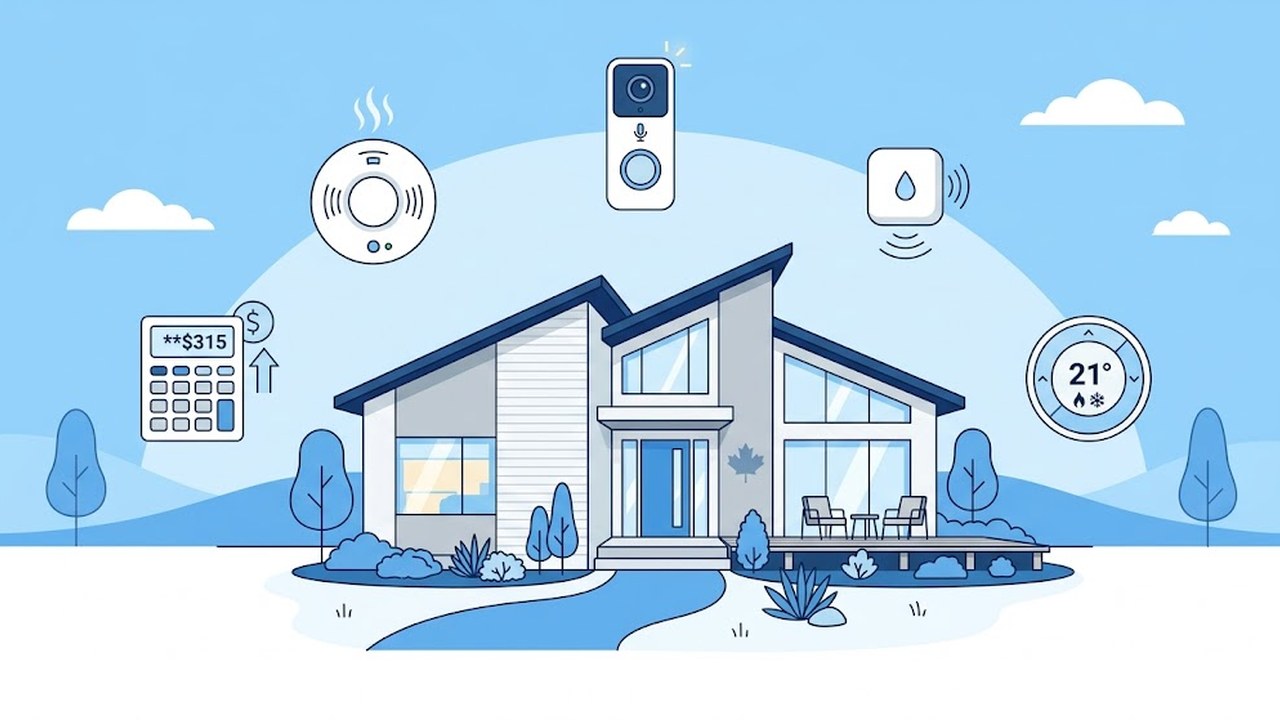
1What You'll Learn in This Guide
Canadian homeowners are quietly leaving hundreds of dollars on the table every year. Insurers across the country now offer real, stackable discounts for smart home devices — but most policyholders never claim them, either because they don't know the discount exists or because they bought the wrong type of device.
The reality is simple: insurers don't reward you for owning gadgets. They reward you for lowering the risk of a claim. A $30 water leak sensor that prevents a $40,000 burst-pipe claim is worth far more to your insurer than a $400 video doorbell that just records the porch.
In this guide, we'll walk through:
- How smart home tech actually changes the math on your premium
- The 8 devices that genuinely move the needle (with realistic discount ranges)
- Insurer partner programs that hand out free or subsidized devices
- Devices that sound great but do nothing for your premium
- How to get the discount actually applied to your policy
- How to stack smart-home credits with other discounts for 25%+ savings
- The ROI math on a $300 leak sensor
- What insurers can — and can't — see from your devices
By the end, you'll know exactly what to install, what to skip, and what to send your insurer to lock in the savings.
4Insurer Partner Programs (Free or Subsidized Devices)
Beyond simple discounts, a growing number of Canadian insurers run partner programs that hand out smart-home devices for free or at a steep discount when you bind a policy. The economics are straightforward: the insurer would rather give you a $200 device than pay a $30,000 water-damage claim two winters from now.
Programs in Canada typically take one of these shapes:
- Free leak detection kit. A starter pack of water leak sensors (usually 3–5 units) plus a hub, shipped to new homeowner policyholders. You install them under sinks, near the water heater, and behind washing machines.
- Subsidized smart shut-off valve. The insurer covers a large portion of the cost of a professionally installed valve in exchange for proof of installation. Some programs make it fully free with a multi-year policy commitment.
- Free smart thermostat. Mostly aimed at preventing freeze damage; the insurer ships the device and may require you to enable certain low-temperature alerts.
- Discounted bundle. A combined kit (sensors + thermostat + smoke detector) offered at near-cost to policyholders.
The devices used in these programs come from a handful of vendors that specialize in insurer-grade telemetry. You don't need to chase a specific brand — when you get a quote, simply ask whether the carrier has a smart-home program and what it includes. If your current insurer doesn't offer one, that alone is a reason to compare quotes.
A subtle but important detail: in most of these programs, the insurer does not get live access to your data. They get an installation confirmation, periodic "device is online" pings, and that's it. Read the program terms so you know exactly what's shared.
5Devices That Don't Actually Help (Or Even Hurt)
Walking into a big-box store and buying anything labelled "smart" will not lower your premium. Several popular categories deliver little or no insurance value, and a few can even create complications.
- DIY non-monitored alarms. A self-installed alarm that only pings your phone may qualify for a small discount — or none. Without 24/7 monitoring by an ULC-listed station, insurers treat it as marginally better than a deadbolt.
- Low-quality / off-brand cameras. Cameras that don't reliably record, that store footage only locally with no backup, or that go offline regularly add no real underwriting value. Insurers want documented deterrence, not a gadget.
- Standalone smart locks. By themselves, smart locks rarely move a premium. They become useful when bundled with monitored entry sensors as part of a full alarm system.
- Unconnected "smart" sensors. A leak sensor that just beeps on the floor — without any hub, app, or alerting — is just a louder version of a regular leak alarm. Insurers want networked sensors that can actually notify you (or a monitoring service) while you're away.
- Generic IoT bulbs, plugs, and speakers. Lights, plugs, and voice assistants have zero impact on your premium. They're convenience devices, not risk-reduction devices.
Worth flagging: a poorly installed device can occasionally complicate a claim. For example, if you install a shut-off valve and disable its automatic mode, then suffer a major leak, an adjuster may ask why the device didn't activate. Always install per manufacturer guidelines and keep documentation.
6How to Get the Discount Applied
Buying the device is only half the job. Insurers don't scan your home for hardware — you have to tell them, prove it, and make sure the credit shows on your declaration page.
Here's the practical sequence Canadian homeowners should follow:
- Contact your insurer or broker as soon as the device is installed. Don't wait for renewal — most insurers will adjust mid-term, and the savings are pro-rated.
- Send installation proof. Typically that means a copy of the invoice or receipt, a photo of the installed device, and the serial number or device ID. For monitored systems, you'll also need the monitoring contract or alarm certificate.
- For monitored systems, request the alarm certificate from your monitoring provider. It should list your address, the type of monitoring (burglary, fire, both), the ULC-listed station, and a 24/7 contact line. This is the single most important document for the full alarm discount.
- Confirm the credit in writing. Ask for an updated declaration page or a written confirmation from your broker. The discount line should be visible — if you can't see it, it isn't there.
- Re-confirm at renewal. Some insurers quietly drop or reduce discounts year over year. Always review your renewal documents and ask why any line item has changed.
If you ever change monitoring providers, replace your alarm, or remove a device, you'll need to notify the insurer too. Claiming a discount for a device that's no longer functional can be treated as misrepresentation.
7Stacking Smart-Home Discounts With Other Discounts
The real magic of smart-home discounts is that they stack with the other credits already available on most Canadian home policies. Done right, the combined effect can easily exceed 25% off your annual premium.
Here's an example of how a typical stack might look on a $1,800 annual policy:
- Home + auto bundle: 10–15%
- Monitored alarm system: 5–15%
- Smart water shut-off valve: up to 15%
- Claim-free for 5+ years: 5–10%
- Mortgage-free homeowner: 5–10% (offered by some insurers)
- New home / new roof: 5–10%
Stacking rules vary by insurer. Some apply discounts multiplicatively, some cap the total credit at a maximum percentage of the base premium, and some won't combine certain credits at all. The takeaway: a single discount looks small, but four or five layered together often turn an $1,800 policy into a $1,300 policy without changing your coverage at all.
This is also where comparing multiple insurers matters most. Carrier A might give a great alarm discount but cap stacking at 20%. Carrier B might give a smaller alarm credit but stack freely with a water-protection discount. Identical homes can end up paying very different premiums depending on how each carrier rewards the same smart-home setup.
8The ROI Math: When a $300 Leak Sensor Pays for Itself
Smart-home devices look like an upfront cost, but the math works out quickly once you fold in the insurance discount and the avoided-claim value. Let's run a realistic Canadian example.
Scenario: A homeowner in Ontario pays $1,800 per year for home insurance. They install:
- A starter water leak sensor system: $300 CAD (hub + 4 sensors)
- Annual insurance discount applied: 7% on the water-protection portion
That 7% discount translates to roughly $126 off the annual premium. The sensors pay for themselves in under 2.5 years on the discount alone.
Now factor in the avoided claim. The average Canadian water-damage claim runs $15,000–$25,000, and even small leaks behind a dishwasher can cause $5,000–$10,000 in damage by the time someone notices. Most policies carry a $1,000–$2,500 deductible plus the long-term cost of a claim on your record — typically a 10–20% premium surcharge for 3–6 years after a claim.
If the sensor catches just one leak in its lifetime, the avoided cost looks something like:
- Avoided deductible: $1,000 – $2,500
- Avoided post-claim surcharge (3 years × ~15% on $1,800): roughly $810
- Avoided out-of-pocket overage and inconvenience: variable but real
Even ignoring the avoided-claim benefit, the discount alone makes most qualifying devices a clear winner. A smart shut-off valve, despite costing more upfront ($800–$1,500 installed in many Canadian homes), often pays back even faster because the discount percentage is larger.
The one place to be careful: don't install devices solely to chase a discount. Install them because they protect your home; the discount is a bonus that makes the math easier.
9Privacy & Data: What Insurers Do With Smart-Home Data
Privacy is the most common — and most reasonable — concern Canadian homeowners raise about smart-home insurance discounts. The good news is that for the vast majority of standard policies, insurers see very little.
What insurers typically see in a standard discount program:
- The fact that you own a qualifying device
- An installation receipt or alarm certificate
- A serial number, device ID, or monitoring station identifier
- For some programs, a periodic "device is online" health ping
What insurers typically do not see:
- Live video or audio from your cameras
- Stored footage from your doorbell or security cameras
- The contents of your smart-home app
- When you're home or away
- Temperature, thermostat schedules, or occupancy patterns
The exceptions are new opt-in usage-based home programs, which are starting to appear in Canada. These are similar in spirit to telematics auto insurance: in exchange for sharing more device data (e.g., sensor health, leak events, freeze events), the homeowner gets a deeper discount. These programs are always opt-in, must be disclosed clearly, and you can leave them.
If privacy matters to you, ask three questions when buying a policy:
- What data does this program collect, specifically?
- How is it stored, for how long, and who can access it?
- What happens to the discount if I opt out later?
A good insurer will answer all three in writing.
10Final Thoughts
Smart-home devices are one of the few areas in home insurance where homeowners have real control over their premium. You can't move your home out of a high-risk postal code, you can't undo a past claim, and you can't change how old your house is. But you can install a leak sensor this weekend and start saving on the next renewal.
The shortest path to maximum savings:
- Prioritize water-damage prevention (sensors + shut-off valve) — that's where the biggest discounts live.
- Get monitored — DIY systems leave money on the table.
- Stack with bundle, claim-free, and other available discounts.
- Send your insurer proof and confirm the credit in writing.
- Compare carriers — the same setup is priced very differently across the Canadian market.
If you already own smart-home tech, you should not be paying full price. And if you don't yet, a $300 starter kit is one of the highest-ROI home upgrades you can make this year.
Powered by Bluecouch
Stop Leaving Smart-Home Discounts on the Table
- Kylie, our AI agent, auto-applies every eligible smart-home discount during your quote
- Instant quotes — see your premium with and without devices in under 90 seconds
- Compare multiple Canadian providers in one place, not one quote at a time
- No broker, no phone tag, no paperwork — fully online from quote to policy
Frequently Asked Questions
In Canada, a professionally installed smart water shut-off valve usually delivers the largest single discount — typically 10–15% — because water damage is now the most expensive and most frequent home insurance claim. Monitored alarm systems come a close second at 5–15%, and a whole-home freeze sensor or a network of water leak sensors can add another 5–10% on top.
Most Canadian insurers only give the full alarm discount if the system is centrally monitored 24/7 by an ULC-listed monitoring station. A DIY system that just sends a notification to your phone usually qualifies for a smaller credit (or none at all) because there is no guaranteed response if you miss the alert. If you want the maximum discount, you generally need a monitoring contract and an alarm certificate to send to your insurer.
Sometimes, but not automatically. A Ring doorbell or Nest thermostat on its own is usually treated as a minor security or efficiency improvement — it might qualify for a small 2–5% discount with insurers that have a smart-home program, or no discount at all with insurers that don't. To get a meaningful credit, the device usually has to be part of a monitored system or installed alongside other qualifying devices like leak sensors or smoke detectors.
Voice-control hubs like Apple HomeKit, Google Home, or Amazon Alexa do not lower your insurance premium by themselves. Insurers care about the physical devices doing the protecting — the leak sensor, the monitored smoke detector, the shut-off valve — not the app you control them with. Having a hub is fine, but the discount comes from the underlying hardware and monitoring, not the platform.
Yes, several Canadian insurers offer discounts of up to 15% for a professionally installed smart water shut-off valve, because it can detect a leak and cut the supply automatically — often preventing tens of thousands of dollars in damage. The exact percentage depends on the insurer, the brand of valve, and whether installation is verified. Some insurers even subsidize or fully provide the device when you bind a new policy.
In standard home insurance policies, no — insurers do not pull live footage from your doorbell or security cameras, and they do not get access to your smart-home app. They only see the data you share, typically the existence of the device, a serial or certificate number, and proof of monitoring. A small number of new opt-in usage-based programs may request additional data, but you must explicitly agree before any of that is shared.
Already have smart home tech? Quote in 90 seconds — Kylie AI auto-applies device discounts.
Get Your Quote