
1Why Your Insurance Valuation Method Matters More Than You Think
When a pipe bursts and destroys your living room floor, or a fire damages your kitchen, the amount your insurance company pays out depends on one critical factor most homeowners overlook: your policy's valuation method.
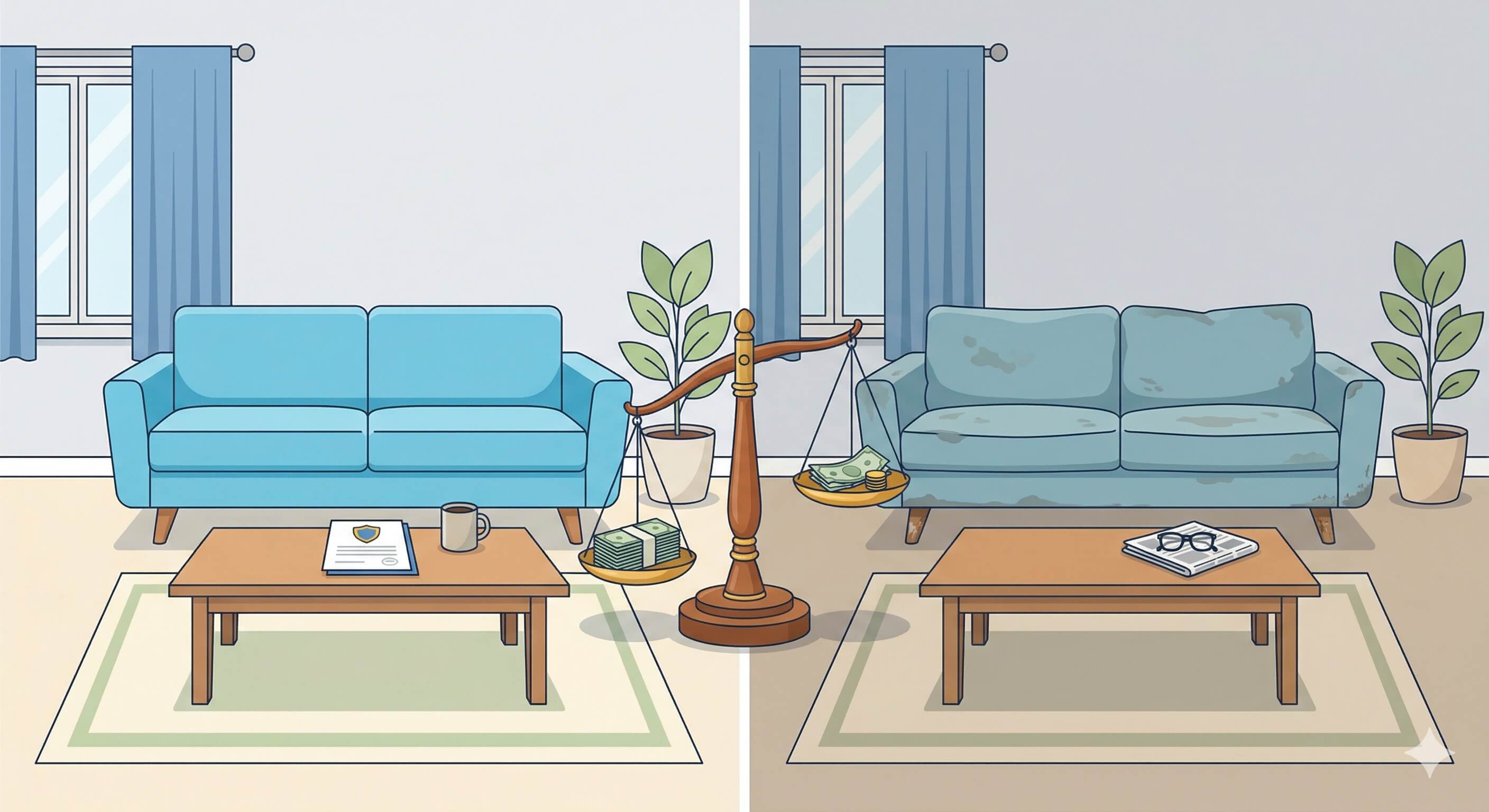
There are two ways Canadian home insurance policies calculate what you're owed after a covered loss: replacement cost and actual cash value (ACV). The difference between these two methods can mean thousands — even tens of thousands — of dollars in your claim payout.
According to the Insurance Bureau of Canada (IBC), many homeowners don't discover which valuation method their policy uses until they file a claim. By then, it's too late to change it.
In this guide, we'll explain exactly how each method works, show you real dollar comparisons, and help you decide which option is right for your situation.
2What Is Replacement Cost Coverage?
Replacement cost coverage pays the full amount needed to replace a damaged or destroyed item with a new one of similar kind and quality — without any deduction for depreciation, age, or wear and tear.
How replacement cost works in practice
If a fire destroys your 8-year-old refrigerator that you originally bought for $1,800, replacement cost coverage would pay the current price of a comparable new refrigerator — say $2,100 — regardless of how old the destroyed unit was. You're restored to the same position you were in before the loss, with a brand-new equivalent item.
Key features of replacement cost
- No depreciation deduction — you receive the full cost to buy new
- Higher premiums — typically 10% to 20% more than ACV policies
- Two-step payout process — many insurers first pay the ACV amount, then reimburse the remaining replacement cost once you've actually purchased the replacement item
- Available for both dwelling and contents — you can have replacement cost on one or both
The two-step payout explained
Most Canadian insurers handle replacement cost claims in two stages:
- Initial payment: The insurer pays you the actual cash value (depreciated value) of the item upfront
- Holdback payment: Once you purchase the replacement item and submit the receipt, the insurer pays the difference between the ACV and the full replacement cost
This means you typically need to buy the replacement within a set period — usually 180 days to 2 years — to collect the full payout. If you don't replace the item, you only receive the ACV amount.
3What Is Actual Cash Value (ACV) Coverage?
Actual cash value (ACV) coverage pays the current market value of a damaged or destroyed item at the time of the loss. This takes into account the item's original cost, its age, and the depreciation it has accumulated over time.
How ACV is calculated
The basic formula insurers use is:
ACV = Replacement Cost - Depreciation
Depreciation is typically calculated as a percentage based on the item's age relative to its expected useful life. For example:
- A laptop with a 5-year useful life that is 3 years old would be depreciated by approximately 60%
- A sofa with a 10-year useful life that is 4 years old would be depreciated by approximately 40%
- A roof with a 25-year useful life that is 10 years old would be depreciated by approximately 40%
Key features of ACV coverage
- Lower premiums — ACV policies are cheaper because the insurer's potential payout is lower
- Depreciation reduces your payout — the older your belongings, the less you receive
- Single payment — you receive one payout based on depreciated value, no need to purchase a replacement first
- Can leave you significantly undercompensated — especially on older items that still have significant utility
When ACV coverage makes sense
ACV coverage may be acceptable if you have mostly new belongings, you're on a very tight budget, or the property is a rental or secondary residence where you're not attached to the contents. However, for most Canadian homeowners, the savings rarely justify the reduced payouts.
4Real Dollar Comparisons: Replacement Cost vs ACV on Common Items
The best way to understand the difference between these two valuation methods is to see real numbers. Here's how payouts would differ across common household items:
| Item | Original Cost | Age | Useful Life | ACV Payout | Replacement Cost Payout | Difference |
|---|---|---|---|---|---|---|
| Asphalt shingle roof | $12,000 | 10 years | 25 years | $7,200 | $15,000 (current price) | $7,800 |
| 55-inch LED TV | $1,200 | 5 years | 7 years | $340 | $1,100 (current price) | $760 |
| Leather sofa | $2,500 | 6 years | 12 years | $1,250 | $2,800 (current price) | $1,550 |
| Washer & dryer set | $2,000 | 8 years | 12 years | $670 | $2,200 (current price) | $1,530 |
| Hardwood flooring (1,000 sq ft) | $8,000 | 15 years | 30 years | $4,000 | $10,500 (current price) | $6,500 |
| Laptop computer | $1,500 | 3 years | 5 years | $600 | $1,500 (current price) | $900 |
| Kitchen cabinets | $15,000 | 12 years | 25 years | $7,800 | $18,000 (current price) | $10,200 |
The total impact on a major claim
Consider a kitchen fire that destroys your cabinets, appliances, flooring, and personal items. Under ACV, you might receive $25,000 to $30,000 for items that would cost $50,000 to $60,000 to replace. That's a $20,000 to $30,000 gap you'd need to cover out of pocket.
For a total loss — where your entire home and contents are destroyed — the gap between ACV and replacement cost payouts can easily exceed $100,000 or more, depending on the age of your home and belongings.
5When Insurers Automatically Switch Your Roof to ACV
One of the most important — and least understood — aspects of Canadian home insurance is the automatic ACV switch on aging roofs. Even if you have a replacement cost policy, your insurer may quietly move your roof coverage to actual cash value once it reaches a certain age.
Common roof age thresholds by material
| Roofing Material | Expected Lifespan | Typical ACV Switch Age |
|---|---|---|
| 3-tab asphalt shingles | 15-20 years | 15-20 years |
| Architectural asphalt shingles | 25-30 years | 20-25 years |
| Metal roofing | 40-70 years | 30-40 years |
| Cedar shake | 20-30 years | 15-20 years |
| Clay/concrete tile | 50+ years | 30-40 years |
What the ACV switch means in real dollars
Suppose a severe hailstorm destroys your 18-year-old asphalt shingle roof. The cost to replace it is $15,000. With replacement cost coverage, you'd receive the full $15,000 (minus your deductible). But if your insurer has switched your roof to ACV, the calculation looks very different:
- Replacement cost: $15,000
- Roof age: 18 years out of 25-year lifespan = 72% depreciated
- ACV payout: approximately $4,200
- Out-of-pocket cost to you: approximately $10,800 plus your deductible
How to protect yourself
- Ask your insurer directly whether your roof is covered at replacement cost or ACV
- Review your policy annually — some insurers notify you of the switch, others simply update the policy at renewal
- Consider replacing your roof proactively before it ages out of replacement cost eligibility
- Get a roof inspection — some insurers will maintain replacement cost coverage if a professional inspection confirms the roof is in good condition
- Shop around — different insurers have different age thresholds, so you may find one that offers replacement cost on an older roof
6Dwelling vs Contents: You May Have Different Valuation Methods
Many Canadian homeowners don't realize that their policy may use different valuation methods for the dwelling (structure) and personal property (contents). Understanding this distinction is essential to knowing your true coverage.
Common policy configurations
| Configuration | Dwelling Valuation | Contents Valuation | Typical Premium Level |
|---|---|---|---|
| Basic | Replacement Cost | Actual Cash Value | Lowest |
| Standard | Replacement Cost | Replacement Cost | Mid-range |
| Premium | Guaranteed Replacement Cost | Replacement Cost | Highest |
What is guaranteed replacement cost?
Guaranteed replacement cost is the gold standard of dwelling coverage. It pays to rebuild your home even if the cost exceeds your policy's dwelling limit. This protects you against unexpected construction cost increases, building code changes, and material price spikes.
Some insurers offer a variation called extended replacement cost, which covers 20% to 50% above your stated dwelling limit. For example, if your dwelling is insured for $500,000 with 25% extended replacement cost, you'd have up to $625,000 in coverage.
Upgrading your contents valuation
If your policy currently covers contents at ACV, upgrading to replacement cost on contents typically adds only $50 to $150 per year to your premium. Given the significant difference in payouts — especially on electronics, furniture, and appliances that depreciate quickly — this upgrade is almost always worth the investment.
To upgrade, simply contact your insurer or broker and request replacement cost coverage on personal property. No home inspection or inventory is typically required for the switch.
7Which Valuation Method Is Better for Your Situation?
While replacement cost coverage is generally the better choice for most homeowners, your ideal valuation method depends on your specific circumstances.
Replacement cost is best if you:
- Own your home and plan to rebuild or fully replace items after a loss
- Have older belongings that still serve you well (furniture, appliances, electronics)
- Want the most comprehensive protection and can afford the slightly higher premium
- Own a newer home where the structure would be expensive to rebuild
- Have significant personal property that would be costly to replace
ACV may be acceptable if you:
- Own a rental property and prioritize keeping premiums low
- Have mostly new belongings with minimal depreciation
- Are on an extremely tight budget and need the lowest possible premium
- Insure a secondary or seasonal property with limited contents
The cost difference in perspective
For the average Canadian home insured at $400,000 to $600,000 in dwelling coverage, upgrading from ACV to replacement cost on both dwelling and contents typically costs an additional $150 to $400 per year. That's roughly $13 to $33 per month.
Compare that to the potential payout difference: on a single major claim involving a roof, kitchen, and contents, replacement cost could pay out $30,000 to $80,000 more than ACV. The math overwhelmingly favours replacement cost for most homeowners.
8Tips for Maximizing Your Replacement Cost Coverage
If you choose replacement cost coverage — and we recommend most Canadian homeowners do — here are steps to ensure you get the full benefit of your policy:
1. Keep your dwelling limit accurate
Your replacement cost coverage is only as good as your dwelling limit. If your home is insured for $400,000 but would actually cost $550,000 to rebuild, you're underinsured. Review your dwelling limit annually and account for rising construction costs. According to Statistics Canada, residential construction costs have increased by approximately 40% to 60% in many provinces since 2020.
2. Document your belongings
Create a detailed home inventory with photos, receipts, and serial numbers. This makes the claims process faster and helps ensure you receive the full replacement cost for every item. Store your inventory in the cloud or a safety deposit box so it survives a total loss.
3. Understand your policy's replacement timeline
Most replacement cost policies require you to purchase replacement items within a specific period — typically 180 days to 2 years after the claim is settled. If you miss this window, you may only receive the ACV payout. Ask your insurer about their specific timeline.
4. Replace with similar quality
Replacement cost covers items of "like kind and quality." You can't claim a $3,000 premium appliance to replace a $1,200 basic model. However, if the exact item is no longer available, insurers will typically cover the cost of the closest equivalent currently on the market.
5. Consider guaranteed replacement cost for your dwelling
If available from your insurer, the guaranteed replacement cost endorsement is one of the best upgrades you can add to your policy. It typically costs an additional $50 to $150 per year and eliminates the risk of being underinsured on your dwelling — even if construction costs spike unexpectedly after a major disaster.
6. Review your roof's coverage status
Contact your insurer to confirm whether your roof is still covered at replacement cost. If it has been switched to ACV, factor the potential out-of-pocket cost into your financial planning and consider whether a proactive roof replacement makes sense.
9The Bottom Line: Replacement Cost Is Worth the Extra Premium
For most Canadian homeowners, replacement cost coverage is the clear winner. The additional $150 to $400 per year in premiums pales in comparison to the thousands — or tens of thousands — of extra dollars you'd receive on a claim.
Actual cash value coverage might save you money on your monthly premium, but it can leave you significantly short when you need your insurance the most. A 10-year-old roof, a 5-year-old TV, or a set of aging appliances might still be perfectly functional, but their ACV could be a fraction of what it costs to replace them.
Take a few minutes to review your current policy. Check whether your dwelling and contents are both covered at replacement cost. Ask about your roof's coverage status. And if you're currently on an ACV policy, get a quote for the replacement cost upgrade — you'll likely be surprised at how affordable the difference is.
The best time to review your valuation method is before you need to file a claim. Don't wait until a loss forces you to confront the gap between what you expected and what your policy actually pays.
Frequently Asked Questions
Replacement cost pays the full amount to replace a damaged or destroyed item with a new one of similar kind and quality, without deducting for depreciation. Actual cash value (ACV) pays the current market value of the item at the time of loss, factoring in age, wear, and depreciation. For example, a 5-year-old TV that cost $1,200 new might have an ACV of only $400, while replacement cost would pay the full $1,200 to buy a comparable new TV.
Replacement cost coverage typically costs 10% to 20% more than an equivalent actual cash value policy. For an average Canadian home, this translates to roughly $100 to $300 more per year. Given that replacement cost payouts can be two to five times higher than ACV payouts on older items, most insurance professionals consider the extra premium well worth the investment.
Yes. Many Canadian insurers automatically switch roofing coverage from replacement cost to actual cash value once a roof reaches a certain age, typically 15 to 25 years depending on the material and insurer. Some insurers may also decline to offer replacement cost on roofs older than 20 years. Contact your insurer to confirm your roof's coverage status and consider replacing an aging roof before the switch occurs.
Depreciation is calculated based on an item's expected useful life, age, and condition. Insurers typically use industry-standard depreciation schedules. For example, if a couch has an expected useful life of 10 years and is 5 years old, it may be depreciated by 50%. The formula is generally: ACV = Replacement Cost minus (Age divided by Useful Life times Replacement Cost). Adjusters may also consider the item's actual condition.
Yes, and this is actually the default setup on many Canadian home insurance policies. Your dwelling (the structure) is often covered at replacement cost by default, while personal property may be covered at actual cash value unless you specifically upgrade to replacement cost on contents. Always check both sections of your policy and consider upgrading contents coverage to replacement cost for better protection.
Not sure which valuation method your policy uses? Get a replacement cost quote and see the difference.
Get Your Quote