

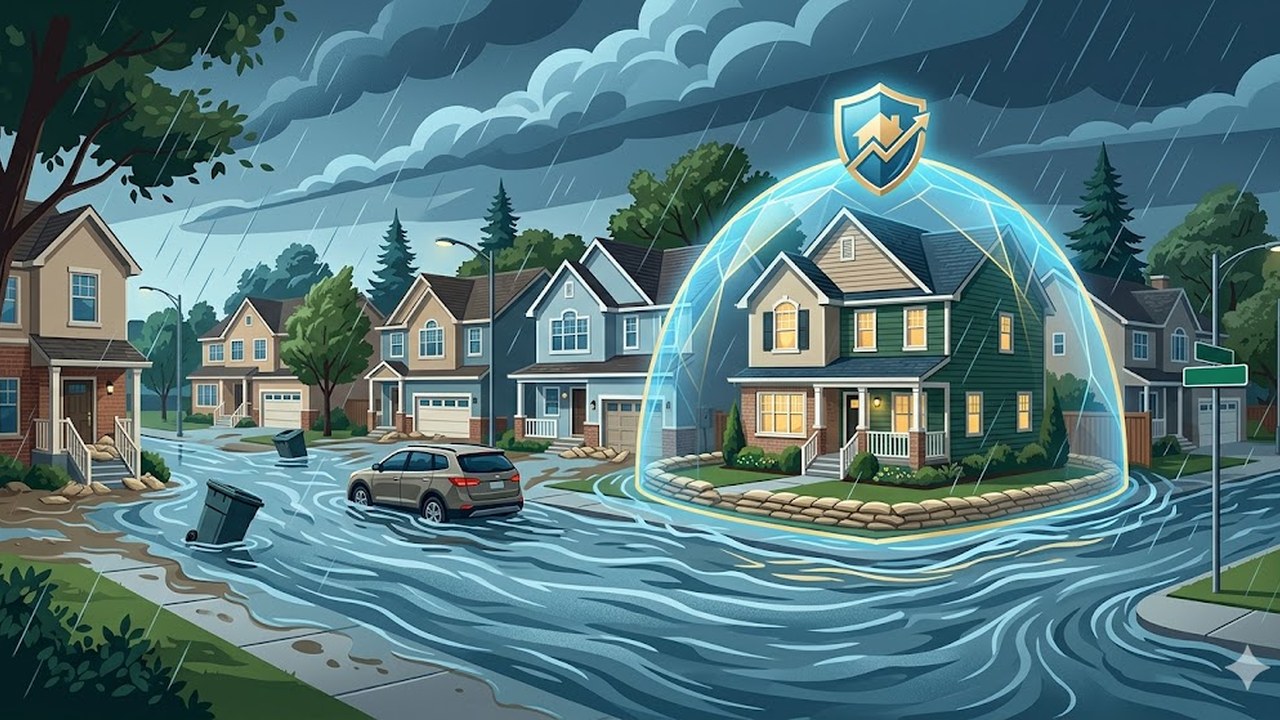
1Canada's Growing Flood Problem
Flooding is the most common and costliest natural disaster in Canada. In 2025 alone, severe weather-related insured losses exceeded $2.4 billion, with flooding responsible for the largest share. Over 1.5 million Canadian households sit in high flood-risk areas — and many don't know it.
Yet despite these staggering numbers, standard home insurance policies in Canada do not cover overland flooding. If a river overflows, if heavy rain pools against your foundation, or if rapid snowmelt sends water into your basement, your basic policy won't pay a cent.
That's where overland water coverage comes in. In this guide, we'll cover:
- What overland water insurance is and what it covers
- How it differs from sewer backup coverage
- How much it costs across Canada
- Who needs it and who is at risk
- What to do if coverage isn't available for your property
2What Is Overland Water Insurance?
Overland water insurance (also called overland flood coverage) is an endorsement you add to your home insurance policy. It protects against damage caused by freshwater that enters your home from outside — specifically from the ground surface or through your foundation.
This includes damage caused by:
- River or lake overflow: When a body of water exceeds its banks and reaches your property
- Heavy rainfall accumulation: When rainwater pools on the ground surface faster than it can drain away
- Rapid snowmelt: Spring thaw events that overwhelm drainage systems and saturate the ground
- Storm surge: In coastal areas, extreme weather pushing water inland
The endorsement typically covers:
- Structural damage to your home (foundation, walls, flooring)
- Personal property destroyed by floodwater
- Cleanup and water extraction costs
- Additional living expenses if you need to relocate during repairs
3Why Standard Policies Exclude Flooding
Until 2015, no Canadian insurer offered overland flood coverage at all. The risk was considered too concentrated — homes in flood-prone areas would file claims repeatedly, making it impossible to price fairly across all customers.
That changed after a series of devastating floods. The 2013 Alberta floods caused $6 billion in total damage, and insurers recognized the market needed a product. Today, most major Canadian insurers offer overland water as an optional endorsement — but with important limitations:
- Not all properties qualify. Homes in the highest-risk flood zones may be declined
- Pricing varies dramatically. A home on high ground might pay $100/year; a home near a flood plain might pay $800+
- Coverage limits may be capped. Some insurers limit overland water claims to $50,000 – $150,000, even if your dwelling coverage is higher
4Overland Water vs. Sewer Backup: Understanding the Difference
One of the most common points of confusion is the difference between overland water coverage and sewer backup coverage. They protect against different types of water damage:
| Feature | Overland Water | Sewer Backup |
|---|---|---|
| How water enters | Through foundation, walls, doors, windows, or ground level | Through internal drains, toilets, sinks, or bathtubs |
| Source of water | External freshwater (rain, rivers, snowmelt) | Sewage or water reversing through the municipal sewer system |
| Typical cost | $100 – $300/year (standard risk) | $30 – $100/year |
| Availability | May be restricted in high-risk flood zones | Widely available across Canada |
During a major rain event, both types of damage can happen simultaneously. Stormwater overwhelms the sewer system (causing sewer backup) while also pooling around your foundation (causing overland flooding). If you only have one endorsement, you're only covered for half the damage.
This is why most insurance brokers recommend purchasing both endorsements together.
5How Much Does Overland Water Coverage Cost?
The cost of overland water coverage varies significantly based on your home's flood risk:
| Risk Level | Annual Cost (Approximate) | Description |
|---|---|---|
| Low risk | $100 – $150 | Home on high ground, no history of flooding, well-drained lot |
| Moderate risk | $150 – $300 | Some proximity to waterways, average drainage, no recent claims |
| High risk | $400 – $1,000+ | Near flood plain, history of area flooding, poor drainage |
| Very high risk | Coverage may be unavailable | Designated flood zone, repeated claims history |
Even at the higher end, consider that the average flood damage claim in Canada exceeds $40,000. For most homeowners, the endorsement is a small price to pay for protection against a risk that is increasing every year due to climate change.
6Who Needs Overland Water Coverage?
The short answer: almost every Canadian homeowner should consider it.
While the risk is higher for some properties, flooding can happen anywhere. Urban areas with aging stormwater infrastructure are just as vulnerable as rural properties near rivers. Consider overland water coverage if:
- Your home has a basement or below-grade living space
- You live near a river, creek, lake, or coastline
- Your area has experienced heavy rainfall events or rapid snowmelt in recent years
- Your neighbourhood has poor drainage or aging storm sewer infrastructure
- You live in a region where climate change is increasing precipitation (this includes most of Canada)
Even if you live on high ground with excellent drainage, an unusually intense rainfall event can overwhelm any drainage system. The 2024 summer flooding season in Canada — the costliest on record at over $7 billion in insured damages for July and August alone — proved that flood risk is no longer limited to traditional flood zones.
7How to Check Your Flood Risk
Before purchasing overland water coverage, it's helpful to understand your specific risk level:
- Check government flood maps: Natural Resources Canada maintains national flood mapping data. Many municipalities also publish their own flood plain maps.
- Ask your municipality: Your local government can tell you whether your property is in a designated flood zone and whether any flood mitigation projects are planned.
- Talk to your insurer: Your insurance provider or broker will know how your property is classified in their rating system and can explain how it affects pricing.
- Look at your property: Is your lot graded so water flows away from the foundation? Are there any low points where water could pool? Is your home downhill from a road or neighbouring property?
8What If You Can't Get Overland Water Coverage?
If your property is in a high-risk flood zone and private insurers won't offer overland water coverage, you still have options:
- Work with a broker: Specialized brokers may be able to find coverage through surplus lines or specialty insurers that standard companies won't offer
- Invest in flood mitigation: Some municipalities offer grants for measures like lot grading, French drains, sump pump upgrades, and foundation waterproofing. These improvements can make your property insurable
- Government disaster assistance: While not a replacement for insurance, provinces do provide Disaster Financial Assistance Arrangements (DFAA) after major floods — though the process is slow and coverage is limited
- National Flood Insurance Program: Canada is currently developing a national flood insurance program to address coverage gaps in high-risk areas. Consult your broker for the latest developments
9Final Thoughts
Flooding is no longer a rare event in Canada — it's the country's most frequent and most expensive natural disaster. Yet standard home insurance still doesn't cover it. Overland water coverage fills that critical gap, and for most homeowners, it costs between $100 and $300 per year.
If you haven't reviewed your policy for overland water coverage, now is the time. Ask your broker whether you're covered, what your limits are, and whether combining overland water with sewer backup coverage makes sense for your property. In a country where flood losses are growing every year, this is one endorsement you don't want to skip.
Frequently Asked Questions
No. Standard home insurance policies in Canada do not cover damage from overland flooding — water that enters your home from outside sources like rivers, heavy rainfall, or snowmelt. You need to purchase a separate overland water endorsement. Without it, flood damage to your home and belongings is entirely your responsibility.
Overland water coverage typically costs between $100 and $300 per year for homes in standard-risk areas. However, homes in designated high-risk flood zones may pay significantly more — between $400 and $1,000+ per year — and some insurers may not offer coverage at all for properties in the highest-risk areas.
You can check your flood risk using Natural Resources Canada's flood mapping tools or your municipality's flood plain maps. Over 1.5 million Canadian households are located in high flood-risk areas. Your insurance broker can also tell you whether your address is flagged as elevated risk, which affects both availability and pricing of overland water coverage.
Overland water coverage protects against flooding from external sources — rivers overflowing, heavy rain pooling, or snowmelt — that enters through your foundation, basement walls, or ground-level openings. Sewer backup coverage protects against water or sewage that enters through your home's internal drain system. A single storm can trigger both, so insurers often recommend purchasing both endorsements.
It depends on the insurer. Some companies offer coverage for high-risk properties at higher premiums, while others may decline coverage entirely. If private insurance is unavailable, check whether your province participates in any government-backed flood insurance programs. Some municipalities also offer grants for flood mitigation measures like grading improvements, sump pump installation, or lot drainage upgrades.
Get your home insurance quote in 90 seconds — ask about overland water coverage.
Get Your Quote