

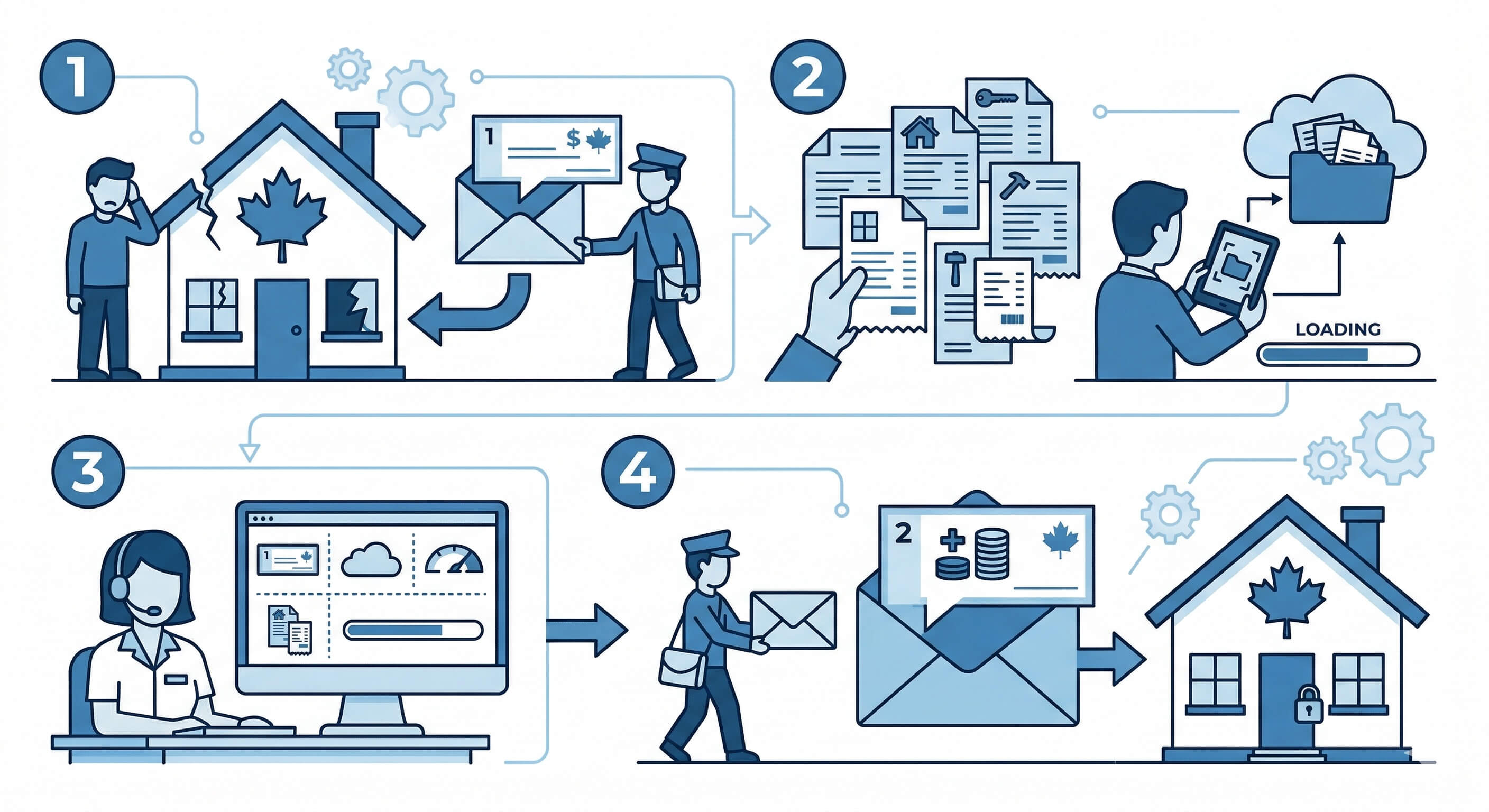
1Your First Cheque Is Rarely Your Final Payout
When you receive your first insurance cheque after a home insurance claim, it may feel like a relief — but it's often only part of what you're owed.
If you have a Replacement Cost Value (RCV) policy, your insurer withholds a portion of your payout as a "holdback" — the accumulated depreciation on your damaged property. This withheld amount is called recoverable depreciation, and it can be released to you once you prove you've actually replaced or repaired what was damaged.
The problem is that many Canadian homeowners don't know this money exists, or they don't know the steps required to claim it — and they forfeit thousands of dollars as a result.
This guide walks you through the entire process, from understanding your settlement letter to submitting your proof of replacement and disputing underpayments.
2Step 1: Confirm Your Policy Includes Replacement Cost Coverage
Before you can recover depreciation, you need to confirm that your policy actually supports it. Recoverable depreciation only exists under Replacement Cost Value (RCV) policies.
How to Check
- Review your policy declaration page — look for the words "Replacement Cost" or "RCV" under your dwelling and/or personal property sections
- If you see "Actual Cash Value" or "ACV," depreciation is not recoverable under that coverage section
- Some policies cover the dwelling at RCV but personal property (contents) at ACV — check both sections separately
If you're unsure, call your insurer or broker and ask: "Is my dwelling covered at replacement cost, and is my personal property covered at replacement cost?"
If either answer is "no," you may want to upgrade your coverage at renewal. The additional premium is typically $100–$300 per year — far less than the depreciation gap on a single major claim.
3Step 2: Read and Understand Your Claim Settlement Letter
After your claim is processed, your insurer will send a claim settlement letter (sometimes called a "loss statement" or "proof of loss"). This document is critical — keep it.
Your settlement letter should show:
- Full replacement cost estimate — what your insurer believes it costs to repair or replace each damaged item new
- Depreciation withheld — the amount held back for each item (sometimes listed as "holdback" or "depreciation deduction")
- ACV payment — the initial cheque amount (replacement cost minus depreciation minus your deductible)
- Submission deadline — the date by which you must submit proof of replacement to claim the withheld depreciation
What to Verify Immediately
Check each line item for the following:
- Is the replacement cost estimate reasonable? Compare it against current contractor quotes or retail prices.
- Is the depreciation calculation correct? Verify the age and lifespan assumptions for each item.
- Is your deductible applied correctly?
If anything looks wrong, raise it with your claims adjuster before cashing your initial cheque, as accepting payment can sometimes be interpreted as agreement with the settlement terms.
4Step 3: Gather the Documents You'll Need
Before you begin repairs or replacements, set up a simple system to track and store all relevant documentation. This will make your Proof of Replacement submission straightforward.
Documents to Collect
| Document Type | Purpose | Who Provides It |
|---|---|---|
| Contractor estimates (2–3) | Supports cost of repair/replacement | Licensed contractors |
| Signed contractor invoices | Proof of work completed and amount charged | Contractor |
| Proof of payment | Confirms you actually paid for the replacement | Bank/credit card statement |
| Retail receipts (for contents) | Proves replacement items were purchased | Store receipts |
| Before/after photos | Visual evidence of damage and completed repair | You / contractor |
| Building permits (if applicable) | Required for structural repairs in many municipalities | Municipal office |
For large-ticket items like a roof or HVAC system, ask your contractor to include a description of materials used and the scope of work on their invoice — this matches the insurer's line-item estimate and speeds up approval.
5Step 4: Complete the Repair or Replacement
You must actually complete the repair or replacement to claim recoverable depreciation. Insurers will not release the withheld amount on your promise alone — documented completion is required.
Key Rules During Replacement
- Replace like for like where possible. If you replace a damaged item with something significantly different, your insurer may limit recoverable depreciation to the estimated cost of the equivalent replacement.
- Don't delay. Contractor availability, supply chain issues, and permit processing can all eat into your deadline. Start the replacement process as soon as possible after receiving your initial payment.
- Notify your adjuster if costs exceed the estimate. If contractor quotes come in higher than your settlement letter amount, contact your adjuster before proceeding. You may be eligible for a supplemental claim to cover the additional cost.
- Keep temporary repair receipts separate. If you made emergency repairs to prevent further damage (e.g., boarding up windows, tarping a roof), these costs are usually separately reimbursable and should not be mixed into your replacement documentation.
6Step 5: Submit Your Proof of Replacement Package
Once your repairs or replacements are complete and you have all your documentation, it's time to submit your Proof of Replacement package to your insurer.
How to Submit
- Contact your claims adjuster by phone or email to confirm the correct submission process and address (or online portal, if available)
- Compile your documents into a single organised package — label each document clearly (e.g., "Roof Replacement Invoice — ABC Roofing — $18,200")
- Include your claim number on every document and in your cover note
- Send via email with read-receipt, registered mail, or through your insurer's online claims portal — keep confirmation of delivery
- Note the date submitted and the name of the person you spoke with
What Happens Next
Your insurer will review the submitted documents and compare your actual replacement costs against their original estimate. Processing typically takes 5 to 15 business days. Once approved, the recoverable depreciation is released as a supplemental payment — by cheque or direct deposit, depending on your insurer.
If your actual costs exceeded the original estimate, the insurer may approve a supplement to cover the difference — or they may limit the payment to the original estimate. If the latter, you have the right to dispute the decision.
7Step 6: How to Dispute if Your Insurer Underestimates
Insurance estimates are not always accurate, and underestimates are common — particularly for roofing, structural repairs, and electronics. If you believe your insurer has undervalued your claim, here is how to challenge it:
Disputing a Depreciation Calculation
- Request a detailed breakdown. Ask your adjuster to provide the specific age, lifespan, and depreciation rate used for each item in dispute.
- Provide counter-evidence. Purchase receipts showing the item was newer than assumed, maintenance records, or a third-party appraisal can override the insurer's assumptions.
- Reference industry standards. For roofing, reference the manufacturer's warranty (e.g., a 30-year shingle warranty supports a 30-year lifespan assumption, not 20).
Disputing a Replacement Cost Estimate
- Obtain 2–3 written quotes from licensed contractors that exceed the insurer's estimate
- Submit these quotes to your adjuster as part of a supplement request
- If your adjuster refuses to revise the estimate, request a formal appraisal process — most Canadian home insurance policies include a binding appraisal clause as an alternative to litigation
Escalation Options
If informal negotiation fails, you have several escalation paths:
- File a complaint with your insurer's internal complaints process
- Contact your provincial insurance regulator (e.g., FSRA in Ontario, AMF in Québec, BCFSA in BC)
- Contact the General Insurance OmbudService (GIO) — a free, independent dispute resolution service for Canadian insurance consumers
8Typical Timelines and What to Expect
Understanding the typical timeline helps you stay ahead of deadlines and manage expectations:
| Milestone | Typical Timeframe |
|---|---|
| Initial ACV payment received | Within 30–45 days of claim approval |
| Deadline to submit proof of replacement | 180 days to 12 months from initial payment |
| Insurer reviews Proof of Replacement | 5–15 business days after submission |
| Supplemental (recoverable depreciation) payment | Within 5–10 business days of approval |
Important: The clock on your recoverable depreciation deadline starts from the date of the initial ACV payment — not from the date of loss. Mark this date clearly and set a reminder at least 60 days before the deadline to ensure you have enough time to complete the replacement and gather documentation.
If you anticipate not being able to complete the replacement within the deadline (e.g., due to contractor availability or supply shortages), contact your insurer proactively to request an extension before the deadline expires. Insurers will often accommodate reasonable requests, but they are far less likely to grant extensions after the fact.
9Don't Leave Your Money on the Table
Recovering depreciation on a home insurance claim is not automatic — it requires action, documentation, and awareness of deadlines. But for homeowners with Replacement Cost Value coverage, the withheld depreciation can represent thousands of dollars that you are fully entitled to receive.
The steps are straightforward: confirm your coverage type, read your settlement letter carefully, complete replacements promptly, gather your documents, and submit your Proof of Replacement well before the deadline.
If you haven't yet reviewed whether your current policy provides RCV coverage for both your dwelling and contents, now is the time. The best moment to understand your coverage is before a claim — not during one.
Powered by Bluecouch
Avoid the Depreciation Trap Before Your Next Claim
- Get quotes for Replacement Cost Value policies — where withheld depreciation is always recoverable
- Compare leading Canadian insurers side by side in under 2 minutes
- Our AI agent Kylie guides you through coverage options so you never overpay or under-insure
- Fully online — no brokers, no paperwork, instant proof of insurance
Frequently Asked Questions
To recover withheld depreciation, you must have a Replacement Cost Value (RCV) policy. After receiving your initial Actual Cash Value (ACV) payment, complete the repair or replacement, collect all receipts and invoices, and submit a Proof of Replacement package to your claims adjuster within the deadline specified in your settlement letter — typically 180 days to 12 months. Once verified, your insurer releases the withheld depreciation as a supplemental payment.
Yes — but only if you have a Replacement Cost Value (RCV) policy. Under an RCV policy, the insurer withholds depreciation from your first payment and releases it once you prove you've replaced the damaged item. Under an Actual Cash Value (ACV) policy, depreciation is never returned. Check your policy documents or call your insurer to confirm which type of coverage you have.
Most Canadian insurers give you between 180 days (6 months) and 12 months from the date of your initial ACV payment to submit proof of replacement and claim your recoverable depreciation. Some policies extend this to 24 months. The deadline is stated in your claim settlement letter. Missing it permanently forfeits the withheld amount, so set a calendar reminder immediately upon receiving your first payment.
If you miss the submission deadline, the withheld depreciation is forfeited — your insurer is no longer obligated to release it. In rare circumstances, insurers may grant extensions if you contact them before the deadline and explain extenuating circumstances. However, this is at the insurer's discretion. Prevention is critical: track your deadline the moment you receive your initial payout.
You will typically need: (1) your original claim settlement letter showing the depreciation withheld; (2) contractor invoices or purchase receipts for replacement items; (3) proof of payment (bank statement, credit card statement, or cheque copy); and (4) any permits if structural work required them. For large repairs like a roof, photos documenting the completed work add helpful supporting evidence.
Yes. If you believe your insurer applied the wrong age, lifespan, or depreciation rate to an item, you have the right to dispute the calculation. Provide evidence such as original purchase receipts, maintenance records, or an independent appraisal. Submit your dispute in writing to your claims adjuster before accepting a final settlement. If the dispute is not resolved satisfactorily, you can escalate to your provincial insurance regulator or request an independent appraisal process.
Get a home insurance quote with full Replacement Cost coverage — no depreciation surprises.
Get Your Quote