

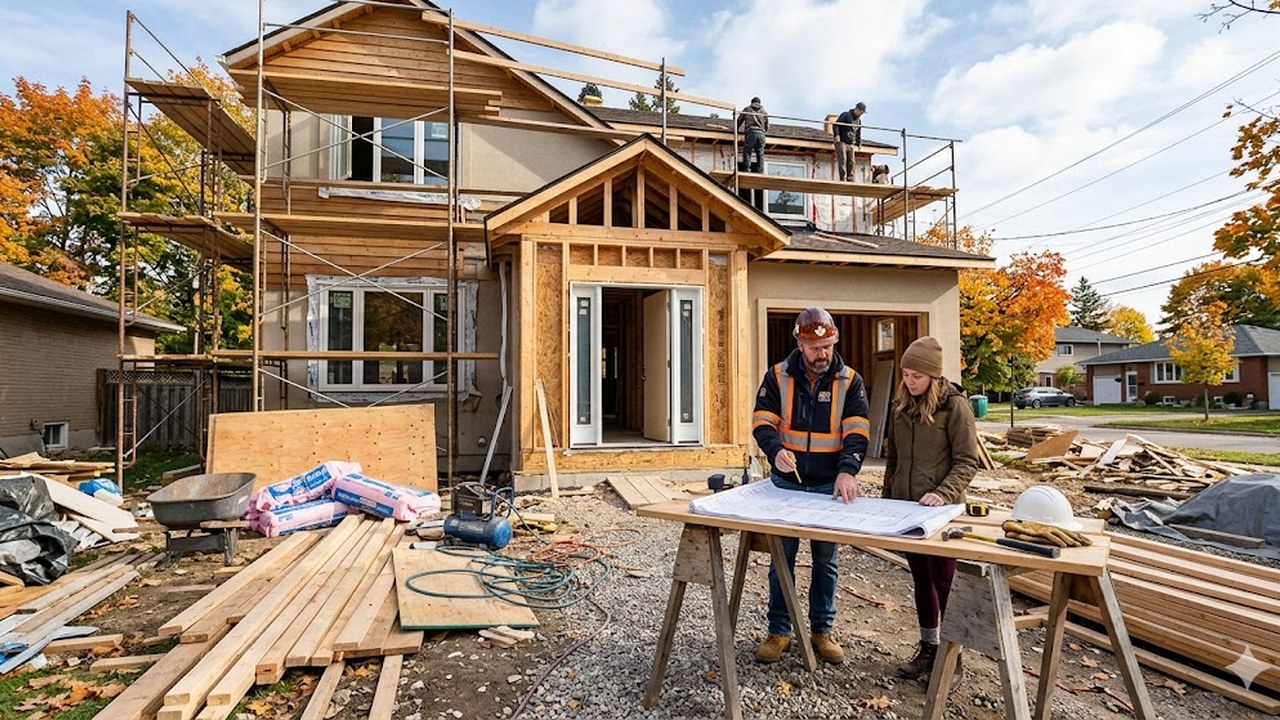
1Your Home Insurance Wasn't Designed for Active Construction
Canadians spend heavily on home renovations. According to Statistics Canada and CMHC, Canadian homeowners spent approximately $80 billion on home renovations and improvements in 2024 — a figure that has grown steadily over the past decade as housing prices made renovating more attractive than moving. From kitchen and bathroom gut renovations to basement finishing, home additions, and major structural upgrades, millions of Canadian homes are active construction sites at any given time.
But here's what most homeowners don't realize: your standard home insurance policy was designed to cover a finished, occupied home — not an active construction site. The moment contractors start tearing out walls, removing your roof, or opening up your foundation, the risk profile of your property changes dramatically. And your insurance coverage may not keep up.
This is a different issue from how renovations affect your insurance after they're completed (which involves rate changes based on your home's updated value and features). This guide focuses specifically on what happens during the construction process — the days, weeks, or months when your home is partially demolished, exposed to the elements, full of construction materials, and occupied by workers.
Understanding these risks — and taking the right steps before the first hammer swings — can prevent catastrophic coverage gaps that leave you paying out of pocket for damage that you assumed was insured.
2Coverage Gaps That Emerge During Renovations
Your standard home insurance policy has several provisions that can create gaps during active renovation. Here are the most common and dangerous ones:
1. Increased Hazard Clause
Most home insurance policies contain an increased hazard clause — a provision that allows your insurer to deny a claim if the hazard level of your property has materially increased. Active construction clearly increases hazards:
- Open walls and exposed framing increase fire risk
- Removed roofing or siding exposes the home to water damage
- Construction materials (solvents, adhesives, wood shavings) are fire accelerants
- Excavation work near the foundation can cause structural instability
- Disconnected plumbing or HVAC systems eliminate freeze protection
2. Vacancy and Unoccupancy Issues
If your renovation requires you to move out — which is common for whole-house renovations, major structural work, or asbestos/mould remediation — your home may trigger the vacancy clause in your policy. Key thresholds:
| Vacancy Duration | Typical Policy Response |
|---|---|
| 1–30 days | Generally covered as normal (short absence) |
| 31–60 days | Many policies restrict coverage — vandalism, water damage, and glass breakage may be excluded |
| 60+ days | Some policies may void coverage entirely; others require a vacancy permit endorsement |
A vacancy permit is a temporary endorsement that maintains coverage while your home is unoccupied. It typically costs $50 to $200 per month and is available from most insurers upon request.
3. Materials and Supplies Not Yet Installed
Your home insurance covers your dwelling and its permanently attached fixtures. But what about the $15,000 worth of kitchen cabinets sitting in your garage waiting to be installed? Or the pallets of flooring material stored in your living room? Construction materials that haven't been installed yet may not be covered under your standard dwelling or contents coverage — they're neither part of the dwelling nor your usual personal property.
4. Contractor-Caused Damage
If your contractor accidentally causes damage — a plumber bursts a pipe, an electrician starts a small fire, or a framing crew damages the existing structure — your home insurance may cover the resulting damage to your home, but it typically won't cover the cost of redoing the contractor's faulty work. That falls on the contractor's own insurance (commercial general liability).
3Course of Construction Endorsement: Your Renovation Safety Net
The most important tool for protecting your home during major renovations is a course of construction (COC) endorsement, also known as a builders risk endorsement. This is a temporary add-on to your existing home insurance policy that fills the gaps created by active construction.
What a COC Endorsement Covers
- Materials and supplies on-site: Building materials, appliances, and fixtures stored at your property waiting to be installed
- Partially completed work: New construction that has been started but not finished — framing, electrical rough-in, plumbing work in progress
- Increased construction risk: Broadens your existing coverage to account for the heightened fire, water, and weather exposure during renovation
- Soft costs: Some endorsements cover additional expenses like architect fees, permit costs, and project management fees if the renovation is delayed due to a covered loss
- Debris removal: Cost to remove damaged construction materials and debris after a loss
What It Doesn't Cover
- Faulty workmanship: If the contractor's work is defective (e.g., improper framing, incorrect wiring), the cost to redo the work is not covered — that's a contractor liability issue
- Contractor's tools and equipment: The contractor's own tools, scaffolding, and equipment are covered by their own insurance, not yours
- Design errors: If the architectural plans are flawed, resulting in additional costs, this is typically not covered
- Mechanical breakdown: Failure of equipment due to normal wear (e.g., a rented excavator breaking down)
Cost and Duration
COC endorsements are priced based on the total value of the renovation project and the expected duration:
| Renovation Value | Typical COC Endorsement Cost | Common Duration |
|---|---|---|
| $25,000–$50,000 | $200–$400 | 2–4 months |
| $50,000–$100,000 | $400–$700 | 3–6 months |
| $100,000–$250,000 | $600–$1,000 | 4–8 months |
| $250,000+ | $1,000–$2,500+ | 6–12 months |
For very large renovation projects (e.g., a full gut renovation or major addition exceeding $300,000), your insurer may recommend a standalone builders risk policy instead of an endorsement, which provides broader coverage with higher limits.
4Contractor Insurance: What to Verify Before Work Begins
One of the most overlooked aspects of renovation insurance is your contractor's own coverage. If your contractor is uninsured or underinsured, you could be left holding the bag for damage, injuries, or liability.
What Every Contractor Should Carry
| Insurance Type | Minimum Recommended | What It Protects |
|---|---|---|
| Commercial General Liability (CGL) | $2,000,000 | Damage caused by the contractor to your property or third parties |
| WSIB/WCB Coverage | Active and in good standing | Workers injured on the job site (your property) |
| Errors & Omissions (E&O) | $1,000,000 (for designers/architects) | Design flaws and professional mistakes |
| Automobile Insurance | $2,000,000 | Contractor vehicles on your property |
How to Verify Contractor Insurance
- Ask for a Certificate of Insurance (COI): This document shows the contractor's policy type, limits, effective dates, and the insurer's name
- Verify the certificate is current: Policies can lapse. Call the insurer listed on the COI to confirm the policy is active
- Ask to be named as an "additional insured": This is standard practice in construction and gives you direct access to the contractor's liability coverage if something goes wrong
- Verify WSIB/WCB clearance: In Ontario, you can check a contractor's WSIB status online at wsib.ca. If a contractor without WSIB coverage has a worker injured on your property, you as the homeowner can be held liable
The Subcontractor Issue
Many general contractors hire subcontractors — electricians, plumbers, drywallers, roofers — to perform specialized work. Ensure your general contractor's insurance covers subcontractor work, or verify that each subcontractor carries their own insurance. An uninsured subcontractor is just as dangerous as an uninsured general contractor.
What If the Contractor Causes Damage?
If your contractor damages your home during renovation (e.g., a plumber floods the basement, an electrician causes a fire):
- The contractor's CGL insurance should cover the damage they caused
- Your home insurance may also respond to the resulting damage to your property (e.g., water damage to existing finishes from a burst pipe during plumbing work)
- Your home insurer may subrogate — meaning they'll pay your claim and then pursue the contractor's insurer for reimbursement
- If the contractor is uninsured: You'll need to sue them personally, which may be fruitless if they don't have assets to collect against
5Liability Risks During Home Renovation
Active construction creates significant liability exposure that goes beyond normal homeownership risks. Here's what you need to know:
Your Liability as a Homeowner
Even though a contractor is doing the work, you remain responsible for your property. Your home insurance personal liability coverage (typically $1 million to $2 million) can be triggered by:
- Visitor injuries: A neighbour, delivery person, or anyone who enters your property and is injured by construction hazards (exposed nails, uneven surfaces, falling materials)
- Trespasser injuries: Children or others who wander onto an unsecured construction site — you may be liable under the "attractive nuisance" doctrine even for trespassers in some provinces
- Neighbour property damage: Excavation that damages a neighbour's foundation, tree removal that falls on their property, or dust/debris that damages their belongings
- Environmental damage: Asbestos or lead paint disturbed during renovation that affects neighbouring properties
Securing the Job Site
To minimize liability exposure during renovation:
- Install proper fencing and barriers around excavation sites, scaffolding, and hazardous areas
- Post warning signs at access points to your property
- Ensure all excavations are covered or fenced when workers aren't on site
- Remove or secure ladders and scaffolding at the end of each work day
- Maintain clear pathways to the main entrance if the home is still partially occupied
- Review your liability limits: Consider increasing your personal liability coverage during major renovations — an umbrella policy providing an additional $1 million to $5 million typically costs only $200 to $500 per year
6Building Permits and Insurance Implications
Building permits aren't just a municipal bureaucratic requirement — they have direct insurance implications that every renovating homeowner needs to understand.
When Do You Need a Permit?
In most Canadian municipalities, you need a building permit for:
- Structural changes (removing or adding walls, changing load paths)
- Additions and extensions (increasing the footprint or height of your home)
- Electrical work (new circuits, panel upgrades, rewiring)
- Plumbing work (new fixtures, rerouting pipes, sewer connections)
- HVAC changes (new furnace, ductwork modifications, gas fitting)
- Roofing (in some municipalities, especially if changing the roof structure)
- Window and door replacements (if changing the size of openings)
- Foundation work (underpinning, waterproofing, structural repairs)
- Basement finishing (if adding bedrooms, bathrooms, or living space)
The Insurance Connection
Your home insurance policy requires that your home comply with applicable building codes and bylaws. If you perform renovation work without the required permits:
- Claims related to the unpermitted work can be denied — if your unpermitted electrical work causes a fire, your insurer has strong grounds to refuse the claim
- Your policy may be voidable for material misrepresentation if you stated (or implied) that your home complied with all applicable codes
- Future sale complications: Unpermitted renovations must typically be disclosed when selling, and the buyer's insurer may require permits to be retroactively obtained (at significant cost) or the work to be redone
Bylaws Coverage Endorsement
There's an important related endorsement that many homeowners overlook: bylaws coverage (sometimes called "building ordinance or law" coverage). This endorsement covers the additional cost of bringing your home up to current building codes after a covered loss. Without it, if a fire damages your 1970s-era electrical panel, your basic policy may only pay to replace it with a similar panel — not to upgrade to a modern panel that meets current code requirements. Bylaws coverage bridges this gap and is especially valuable for older homes.
7When and How to Notify Your Insurer About Renovations
Here's a practical guide to when you need to notify your insurer and what to communicate:
Renovations That Require Notification
| Renovation Type | Notify Insurer? | Likely Policy Changes |
|---|---|---|
| Painting, cosmetic updates | No | None |
| New flooring (same type) | No | None |
| Minor bathroom refresh (fixtures only) | No | None |
| Kitchen renovation (cabinets, counters, appliances) | Yes — if scope is large | May need COC endorsement; dwelling limit increase after completion |
| Bathroom gut and rebuild | Yes | COC endorsement recommended; dwelling limit increase |
| Basement finishing | Yes | COC endorsement; dwelling limit increase; may need sewer backup coverage review |
| Removing or adding walls | Yes | COC endorsement required; structural engineering confirmation may be needed |
| Home addition | Yes — immediately | COC endorsement or standalone builders risk; significant dwelling limit increase |
| Roof replacement | Yes | COC endorsement if major structural work; premium may decrease after completion |
| Foundation work (underpinning, waterproofing) | Yes — immediately | COC endorsement required; potential temporary coverage restrictions |
| Whole-house renovation | Yes — immediately | Standalone builders risk policy likely needed; vacancy permit if moving out |
What to Tell Your Insurer
When you call, provide the following information:
- Scope of work: What's being done, in as much detail as possible
- Estimated cost: The total project budget (this determines the COC endorsement premium)
- Timeline: Expected start and completion dates
- Contractor information: Name of the general contractor and confirmation they're insured
- Permits: Whether permits have been obtained
- Occupancy: Whether you'll continue living in the home or need to move out
- Post-renovation value: The expected increase in your home's replacement cost after the renovation is complete
Timing Matters
Contact your insurer at least 2 weeks before work begins. This gives them time to:
- Review the scope and assess any additional risk
- Issue a COC endorsement or arrange alternative coverage
- Add a vacancy permit if you'll be moving out
- Adjust your dwelling coverage limit to include the renovation value
- Confirm that your contractor's insurance meets their requirements
8Renovate with Confidence: A Pre-Construction Insurance Checklist
Renovating your home should be exciting — not a source of financial anxiety. By taking the right insurance steps before construction begins, you can renovate with the confidence that you're protected throughout the process.
Your Pre-Renovation Insurance Checklist
- Notify your insurer at least 2 weeks before work starts — describe the scope, cost, and timeline
- Ask about a course of construction endorsement for any renovation exceeding $25,000 or involving structural work
- Arrange a vacancy permit if you'll be moving out for more than 30 days
- Verify your contractor's insurance: CGL ($2M minimum), WSIB/WCB, and ask to be named as additional insured
- Verify subcontractor insurance — don't assume the GC's policy covers all subs
- Obtain all required building permits before work begins
- Review your liability coverage — consider increasing limits or adding an umbrella policy during major construction
- Secure the construction site — fencing, signage, and daily cleanup reduce both risk and liability
- Update your dwelling coverage limit after the renovation is complete to reflect the increased replacement cost
- Keep all documentation: permits, inspection reports, contractor invoices, and COI certificates — you'll need them if you ever file a claim
The cost of proper renovation insurance — typically a few hundred dollars for a COC endorsement — is trivial compared to the tens or hundreds of thousands of dollars at stake if something goes wrong during construction. Protect your investment, protect your home, and renovate with peace of mind.
Frequently Asked Questions
It depends on the scope of the renovation. Minor cosmetic updates like painting, flooring, or updating fixtures are generally covered by your standard home insurance without any changes needed. However, major structural renovations — such as additions, foundation work, removing walls, or complete kitchen and bathroom gut renovations — can create coverage gaps or trigger policy exclusions. For major renovations, you should notify your insurer and may need a course of construction endorsement or a separate builders risk policy.
A course of construction endorsement (also called a builders risk endorsement) is an add-on to your home insurance policy that extends coverage to include risks specific to renovation and construction work. It typically covers damage to materials and supplies on-site, damage to partially completed work, theft of building materials, and additional construction risks that your standard policy excludes. The endorsement is temporary — it's added when renovation starts and removed when the work is completed. Cost is typically $200 to $1,000 depending on the project scope and duration.
You don't necessarily need to move out, but if your renovation makes the home uninhabitable and you do leave, your home may be classified as vacant by your insurer. Most home insurance policies have a vacancy clause that restricts or eliminates coverage after 30 consecutive days of vacancy. This means perils like vandalism, water damage, and glass breakage may no longer be covered. If you plan to move out during renovations, notify your insurer immediately — they may add a vacancy permit or adjust your policy to maintain coverage.
Absolutely. Before any contractor begins work on your home, you should verify they carry both commercial general liability (CGL) insurance with a minimum of $2 million in coverage and workplace safety insurance (WSIB in Ontario, WCB in other provinces). Ask for a current certificate of insurance and verify it is active. If a contractor without proper insurance causes damage to your home, injures someone on your property, or one of their workers is hurt on the job, you could be held personally liable. Your home insurer may also deny claims related to work done by uninsured contractors.
You should notify your insurer before the renovation begins — ideally at least two weeks before work starts. This gives your insurer time to review the scope of work, adjust your policy if needed, add any necessary endorsements, and update your dwelling coverage limit to reflect the increased value after renovation. Failing to notify your insurer about major renovations is considered a material change in risk. If something goes wrong during the renovation and you haven't disclosed it, your insurer can deny the claim.
Planning a renovation? Don't start without verifying your coverage. Get a quote that protects you during construction.
Get Your Quote