

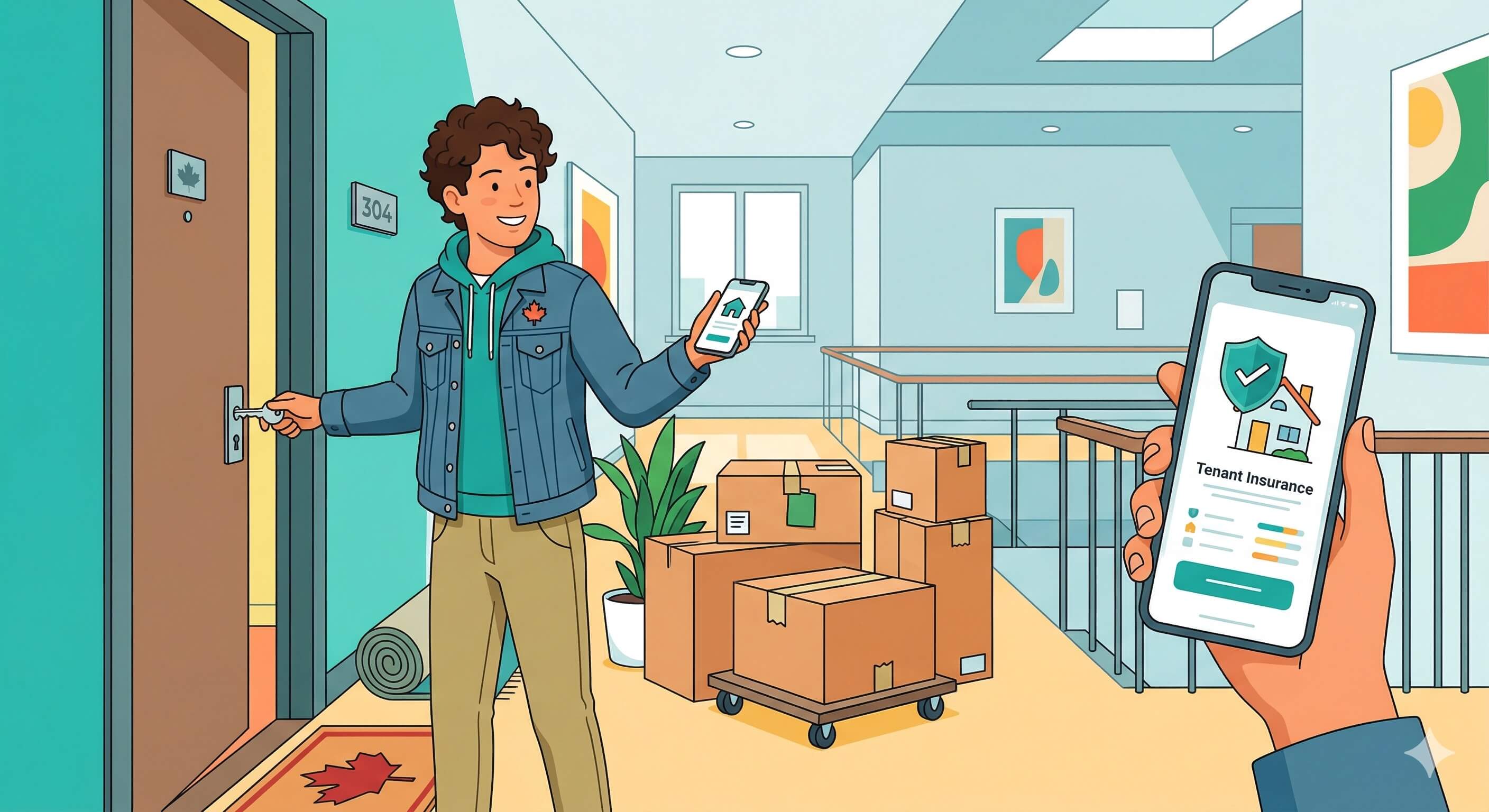
1Moving Into Your First Rental? Read This First
Congratulations — you're getting your own place. Whether it's your first apartment after school, a room in a shared house, or your first solo studio, this is an exciting milestone. But amidst the furniture shopping, lease signing, and address changes, there's one essential step most first-time renters overlook: tenant insurance.
Here's the uncomfortable truth: your landlord's insurance covers the building, but it does not cover you, your belongings, or your liability. If a fire destroys your apartment, your landlord's policy will rebuild the unit — but everything inside it? That's on you.
The good news: tenant insurance is cheap, easy to get, and incredibly valuable. For $15 to $30 per month, you're protected against losses that could otherwise cost you tens of thousands of dollars.
This guide covers everything a first-time renter needs to know — no jargon, no assumptions, just clear answers.
2What Is Tenant Insurance?
Tenant insurance (also called renters insurance) is a policy that protects you — the renter — from financial loss. It covers your stuff, your liability, and your living costs if something goes wrong.
It does not cover the building itself (that's your landlord's insurance), and it does not cover your roommate's belongings unless they're a named insured on your policy.
Think of tenant insurance as three protections in one:
- Your belongings — if they're stolen, damaged by fire, destroyed by water, or lost in other covered events
- Your liability — if someone gets hurt in your apartment, or if you accidentally cause damage to the building or other people's property
- Your living costs — if your apartment becomes uninhabitable and you need somewhere to stay temporarily
3What Tenant Insurance Covers
1. Personal Property (Your Stuff)
This is the coverage most people think of first. It protects everything you own inside your rental — and some things outside it too:
- Inside your rental: Furniture, electronics (TV, laptop, gaming console), clothing, kitchen items, bedding, decorations, books, personal care appliances
- In your car: If your laptop bag is stolen from your car, your tenant insurance covers it (your auto insurance does not cover personal items in your vehicle)
- While travelling: Your belongings are covered up to a limit (usually 10% of your contents coverage) while you're temporarily away from home
- In a storage locker: Items in your building's storage unit are typically covered
How much coverage do you need? Walk through your apartment mentally and add up the cost to replace everything. Most first-time renters have $20,000 to $40,000 worth of belongings — more than they think.
2. Personal Liability
This is arguably the most important coverage — even more than contents — and the one most renters don't think about.
Liability coverage protects you if:
- A friend visits and slips on your wet bathroom floor, breaking their arm
- You accidentally leave a candle burning and it starts a fire that damages the building
- Your bathtub overflows and water damages the apartment below
- Your dog bites a visitor
Without liability coverage, you pay for medical bills, legal defence, and court-ordered damages out of your own pocket. A serious injury claim can easily reach $500,000 to $1,000,000.
Standard policies include $1 million in liability coverage. Upgrading to $2 million costs only $20 to $40 more per year — worth it.
3. Additional Living Expenses (ALE)
If your apartment becomes uninhabitable due to a covered loss — fire, major water damage, structural damage — ALE coverage pays for:
- Hotel or temporary rental accommodation
- Restaurant meals (the increased cost above your normal food expenses)
- Laundry services
- Other reasonable expenses
ALE is typically capped at 20% to 30% of your contents coverage. On a $30,000 contents policy, that's $6,000 to $9,000 in living expenses.
4What Tenant Insurance Does NOT Cover
Understanding the exclusions is just as important as understanding the coverage:
- The building itself: The structure, roof, exterior — that's your landlord's insurance
- Your car: Vehicle damage is covered by auto insurance, not tenant insurance. However, personal items stolen from your car ARE covered by tenant insurance
- Roommate's belongings: Unless they're a named insured on your policy
- Flood and sewer backup: Standard policies exclude these — you need to add endorsements (discussed below)
- Earthquake: Requires a separate endorsement
- Wear and tear: If your couch cushions flatten over time, that's not an insurable event
- Pest damage: Bed bugs, mice, and other infestations are not covered
- Intentional damage: Anything you do on purpose
- Business equipment and inventory: If you run a business from your rental, you need separate commercial or home business coverage
5How Much Does It Cost?
Tenant insurance is one of the most affordable types of insurance in Canada:
| Profile | Monthly Cost | Annual Cost |
|---|---|---|
| Student / minimal belongings | $12 – $18 | $144 – $216 |
| Young professional / moderate belongings | $18 – $28 | $216 – $336 |
| Established renter / significant belongings | $25 – $40 | $300 – $480 |
To put this in perspective: tenant insurance costs less than most streaming subscriptions — and protects against losses that could take years to recover from.
What Affects Your Premium
- Location: City centre apartments in Toronto or Vancouver cost more than suburban or rural rentals due to higher theft and liability risk
- Contents coverage amount: More coverage = higher premium (but the increase is modest — going from $30K to $50K might add $5 to $10/month)
- Deductible: A higher deductible ($1,000 vs. $500) lowers your premium by 10% to 20%
- Building type: Apartments in secured buildings may cost less than basement apartments or ground-floor units
- Claims history: A clean record means lower rates
- Endorsements: Adding sewer backup or earthquake coverage increases the premium slightly
6Endorsements First-Time Renters Should Consider
Beyond the standard coverage, these endorsements fill important gaps:
Sewer Backup ($30 – $75/year) — Highly Recommended
If sewage or water backs up through your drains, toilets, or sinks, standard tenant insurance won't cover the damage. A sewer backup endorsement adds this protection for a very low cost. This is especially important for ground-floor and below-grade apartments.
Overland Water ($50 – $200/year) — Recommended for Ground-Floor Units
Protects against flooding from external sources (heavy rain, snowmelt) entering through doors, windows, or the foundation. Most relevant for ground-floor and basement apartments.
Earthquake ($50 – $300/year) — Recommended in BC and Quebec
If you live in British Columbia's Lower Mainland, Vancouver Island, or the Quebec/Ottawa corridor, earthquake coverage protects your belongings from seismic damage.
Identity Theft ($25 – $75/year) — Nice to Have
Covers expenses related to identity theft recovery — legal fees, credit monitoring, lost wages from time spent resolving the issue.
7How to Get Tenant Insurance: Step-by-Step
Getting covered takes about 10 minutes. Here's the process:
Before You Start
Have the following ready:
- Your rental address (or future address if you're moving)
- An estimate of your belongings' replacement value
- Move-in date (when you need coverage to start)
- A payment method (credit card or bank account for pre-authorized payments)
Step 1: Get Quotes
Get quotes from at least three providers. You can do this online in minutes. Compare not just price, but coverage limits, deductibles, and included endorsements.
Step 2: Choose Your Coverage
- Contents coverage: Set to the replacement value of your belongings ($20,000 to $40,000 for most first-time renters)
- Liability: $1 million minimum, $2 million recommended
- Deductible: $500 for maximum protection, $1,000 for lower premiums
- Endorsements: Add sewer backup at minimum
Step 3: Activate Your Policy
Set the start date to your move-in date (or earlier if you're storing belongings at the new address before officially moving). Most policies can be activated the same day you apply.
Step 4: Get Proof for Your Landlord
If your landlord requires proof of insurance, request a certificate of insurance or declaration page from your insurer. Most companies can provide this electronically within minutes.
Step 5: Document Your Belongings
After moving in, take a video walkthrough of every room, opening closets and drawers to show your belongings. Upload it to cloud storage. This documentation is invaluable if you ever need to file a claim.
8Questions Every First-Time Renter Asks
"I don't own much — is insurance really worth it?"
Yes. Even if your belongings are modest, the liability coverage alone is worth the cost. If a guest is injured in your apartment and sues, or if you accidentally cause a fire, you could face hundreds of thousands in costs. Tenant insurance covers legal defence and damages — for $15 to $30/month.
"My landlord says I need insurance — is that legal?"
Yes. Landlords in most Canadian provinces can require tenants to carry tenant insurance as a condition of the lease. This is increasingly common, especially in apartment buildings and managed properties. Even if it's not required, it's strongly recommended.
"What if I'm renting a room in someone's house?"
You still need your own tenant insurance. The homeowner's policy covers the house and the homeowner's belongings — not yours. Your personal policy covers your belongings in your room and provides you with liability protection.
"Can I cancel anytime?"
Yes. Most tenant insurance policies can be cancelled at any time, and you'll receive a prorated refund for the unused portion of your premium. If you move, you can transfer your policy to your new address instead of cancelling.
"What if I move during the policy term?"
Simply call your insurer and update your address. Your policy transfers to the new location. Your premium may change slightly based on the new address's risk profile, but the transition is seamless — no gap in coverage.
9Final Thoughts
Tenant insurance is one of the smartest financial decisions you'll make as a first-time renter. For $15 to $30 per month — less than a single restaurant meal — you're protected against fires, theft, water damage, liability claims, and displacement from your home.
Getting covered takes 10 minutes. Set your contents coverage to match your belongings' actual value, choose $1 to $2 million in liability, add sewer backup coverage, and take a video inventory of your possessions. That's it — you're protected.
The cost of tenant insurance is tiny. The cost of not having it, when something goes wrong, can be life-changing. Get covered before you move in.
Powered by Bluecouch
Your First Tenant Insurance Policy — Set Up in Minutes
- Answer a few simple questions and get your quote instantly
- Affordable coverage — tenant insurance plans starting from $10/month
- Kylie, our AI agent, explains every step so nothing feels confusing
- Get covered today — no waiting period, no broker needed
Frequently Asked Questions
While tenant insurance is not legally required in most provinces, it is strongly recommended — and many landlords require it as a condition of your lease. Without it, you're personally responsible for replacing all your belongings after a fire or theft, covering legal costs if someone is injured in your apartment, and paying for temporary housing if your unit becomes uninhabitable. At $15 to $30 per month, it's one of the most affordable protections available.
Tenant insurance covers three main areas: personal property (your belongings — furniture, electronics, clothing, kitchen items), personal liability (legal and medical costs if someone is injured in your rental or you accidentally damage property), and additional living expenses (hotel and meals if your rental becomes uninhabitable due to a covered loss like fire or flood). It does not cover the building itself — that's your landlord's responsibility.
First-time renters in Canada typically pay between $15 and $30 per month for tenant insurance. The exact cost depends on your location, the amount of contents coverage you choose, your deductible, and whether you add endorsements like sewer backup. Students and young renters with fewer belongings can often find basic coverage for $12 to $18 per month.
It depends on your situation. If you're a student living away from home temporarily (at college or university), your parents' home insurance may extend limited coverage to your belongings at your school address — typically up to 10% of their contents coverage. However, this coverage is limited, may not include liability protection at your rental, and ends when you're no longer a dependent student. Getting your own tenant insurance is strongly recommended.
You can get tenant insurance online in as little as 5 to 10 minutes. Many insurers offer instant quotes and same-day coverage. You'll need your rental address, an estimate of your belongings' value, and a payment method. Some insurers can have your policy active within hours of applying — making it easy to arrange even at the last minute before moving in.
Get your tenant insurance quote in 90 seconds — plans start at $12/month.
Get Your Quote