

1Canada's Hidden Earthquake Risk
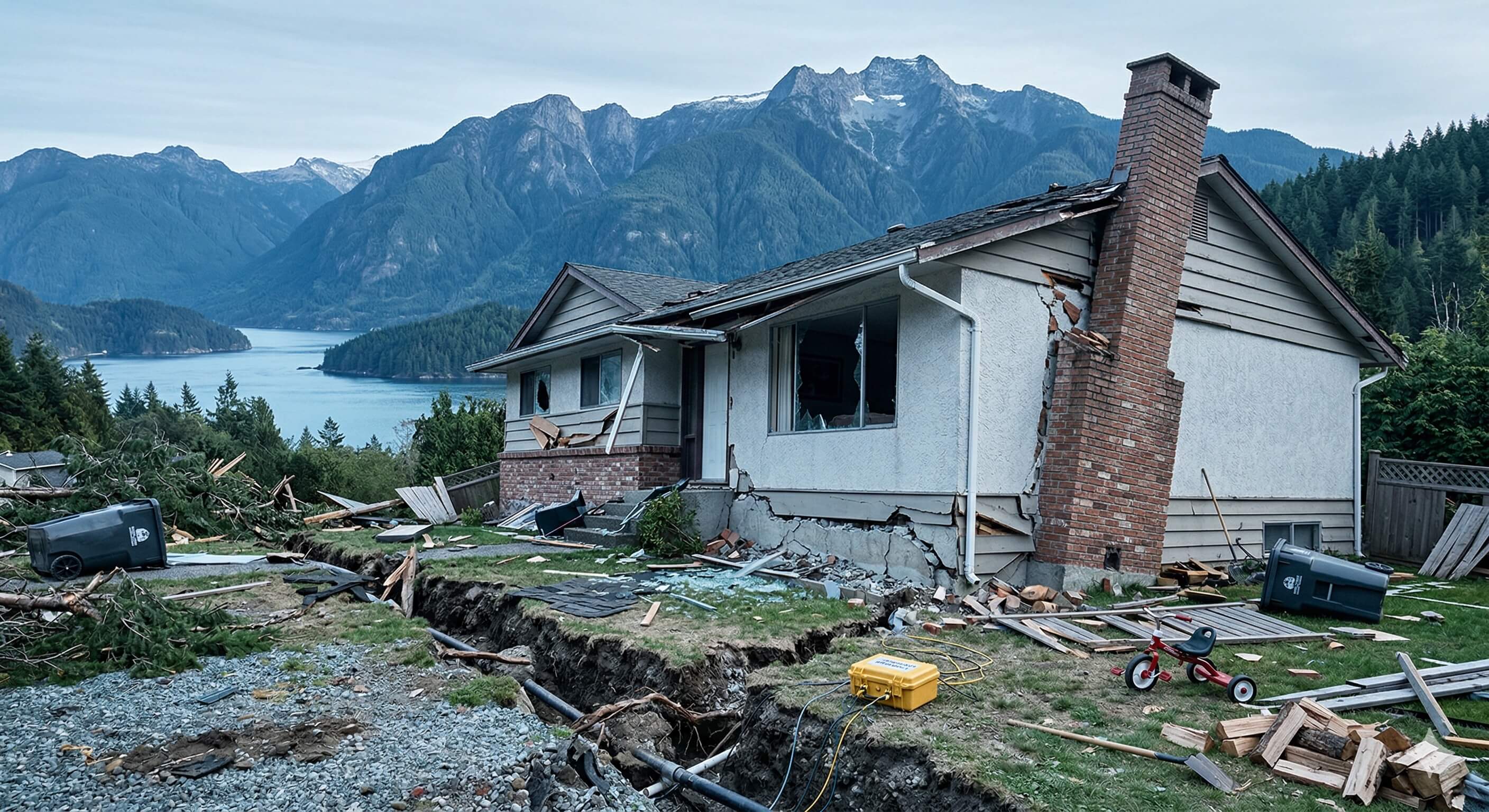
Most Canadians don't think of their country as earthquake-prone. But Canada experiences approximately 4,000 earthquakes every year — most too small to feel, but some capable of catastrophic damage. The last truly destructive earthquake in a populated area was the 1946 Vancouver Island earthquake (magnitude 7.3), but seismologists warn it's not a question of if but when the next major one strikes.
Despite this risk, standard home insurance in Canada does not cover earthquake damage. If a quake cracks your foundation, shifts your home off its frame, or collapses a wall, your basic policy won't pay anything. You need a separate earthquake endorsement — and the decision to buy one depends on where you live, what your home is built from, and how much risk you're willing to accept.
2Canada's Earthquake Risk Zones
Not all of Canada faces the same seismic risk. Here are the key zones:
Highest Risk: British Columbia's Coast
BC sits on the Cascadia subduction zone, where the Juan de Fuca tectonic plate slides beneath the North American plate. This is the same type of fault that caused the 2011 Japan earthquake and tsunami. Natural Resources Canada estimates a 30% probability of a major earthquake (magnitude 8.0+) within the next 50 years. Victoria, Vancouver, and the Lower Mainland are directly in this zone.
High Risk: Quebec and the Ottawa Valley
The St. Lawrence rift system runs from Montreal through Quebec City and into the Charlevoix region. This area has produced some of Canada's strongest recorded earthquakes, including the 1925 Charlevoix earthquake (magnitude 6.2) and the 1988 Saguenay earthquake (magnitude 5.9). Ottawa, Montreal, and Quebec City all sit within this active zone.
Moderate Risk: Other Regions
Parts of the Yukon, Arctic Canada, and the Fundy region of New Brunswick experience moderate seismic activity. The Prairies, central Ontario, and the Maritime provinces face comparatively lower risk, though no part of Canada is completely immune to earthquakes.
3What Does Earthquake Insurance Cover?
An earthquake endorsement or standalone policy typically covers:
- Structural damage: Foundation cracks, wall collapses, shifted framing, chimney damage, and damage to attached structures like garages
- Personal property: Furniture, electronics, clothing, and other belongings damaged by the earthquake or resulting structural failure
- Additional living expenses: Hotel, meals, and temporary housing if your home is uninhabitable during repairs
- Debris removal: The cost of clearing wreckage before reconstruction can begin
What It Does NOT Cover
- Tsunami damage: Even if triggered by an earthquake, tsunami flooding requires separate coverage
- Fire following earthquake: Some policies cover this, others don't — check your specific wording carefully
- Landslide: Ground movement triggered by an earthquake may or may not be included
- Pre-existing damage: Cracks or structural issues present before the earthquake won't be covered
- Vehicles: Your car is covered under comprehensive auto insurance, not earthquake home insurance
4How Much Does Earthquake Insurance Cost?
Earthquake insurance pricing depends on three main factors: location, construction type, and coverage amount.
| Region | Annual Premium (Typical Home) | Typical Deductible |
|---|---|---|
| BC Coast (Vancouver, Victoria) | $400 – $800+ | 10% – 15% |
| BC Interior | $150 – $400 | 5% – 10% |
| Quebec / Ottawa Valley | $100 – $400 | 5% – 10% |
| Ontario (outside Ottawa) | $50 – $150 | 5% – 10% |
| Prairies | $30 – $100 | 5% |
| Atlantic Canada | $40 – $120 | 5% |
Understanding Percentage-Based Deductibles
Earthquake deductibles are unlike regular home insurance deductibles. Instead of a flat dollar amount, they are a percentage of your dwelling coverage:
- Home insured for $400,000 with a 10% deductible = you pay the first $40,000
- Home insured for $600,000 with a 15% deductible = you pay the first $90,000
This means earthquake insurance is most useful for catastrophic events — where damage exceeds your deductible significantly. For moderate damage (cracked foundation, chimney repair), you may still end up paying out of pocket.
5How Your Home's Construction Affects Earthquake Risk
The way your home is built dramatically affects both its vulnerability to earthquakes and your insurance premium:
| Construction Type | Earthquake Risk | Premium Impact |
|---|---|---|
| Wood frame | Lower — wood is flexible and absorbs seismic energy well | Lowest premiums |
| Reinforced concrete | Moderate — depends on age and whether seismic standards were used | Moderate premiums |
| Unreinforced masonry (brick, stone) | Highest — rigid materials crack and collapse under seismic stress | Highest premiums; some insurers decline |
| Post-and-beam | Moderate — connections between beams are vulnerable points | Moderate to high premiums |
Homes built to modern seismic building codes (generally post-1990 in BC, post-2005 nationally) are more resilient and may qualify for lower earthquake insurance rates.
Retrofitting for Earthquake Resilience
If you own an older home in a high-risk zone, consider seismic retrofitting:
- Bolt the house to the foundation: Many older homes simply sit on their foundation without being secured. Bolting prevents the structure from sliding off during shaking.
- Brace the cripple walls: The short wooden walls between the foundation and the first floor are often the first point of failure. Plywood bracing strengthens them significantly.
- Secure the water heater: Strapping your water heater to the wall prevents it from tipping and rupturing gas or water lines.
- Reinforce the chimney: Unreinforced masonry chimneys are the most commonly damaged element in moderate earthquakes.
6Do You Need Earthquake Insurance?
The answer depends on your specific situation. Here's a framework:
You Probably Need It If:
- You live in BC's Lower Mainland, Vancouver Island, or the Sea-to-Sky corridor
- You live in the Ottawa-Montreal-Quebec City corridor
- Your home is your largest financial asset and you couldn't afford to rebuild without insurance
- You have a mortgage — your lender may require earthquake coverage in high-risk zones
- Your home is unreinforced masonry (brick or stone without steel reinforcement)
You Might Skip It If:
- You live in a low-risk region (Prairies, most of Ontario, Atlantic Canada)
- Your home is wood-frame construction built to modern codes — the most earthquake-resilient type
- You have sufficient savings to cover the high deductible plus potential out-of-pocket costs
- The premium-to-coverage ratio doesn't make financial sense for your area
The Financial Calculation
Consider this: if your home is insured for $500,000 and your earthquake deductible is 10%, you'd pay the first $50,000 out of pocket in a claim. Is the remaining coverage — potentially $450,000 — worth the annual premium? For most homeowners in high-risk zones, the answer is clearly yes. In a major earthquake, damage routinely exceeds $100,000 to $200,000 for individual homes.
7Preparing Your Home for an Earthquake
Insurance is one part of earthquake preparedness. Here are practical steps every homeowner in a risk zone should take:
- Secure heavy furniture: Bolt bookshelves, cabinets, and large appliances to wall studs. Use earthquake putty or museum wax under fragile items on shelves.
- Know your shutoffs: Learn how to turn off your gas, water, and electricity. Keep a wrench near the gas shutoff valve.
- Create a 72-hour emergency kit: Water (4 litres per person per day), non-perishable food, flashlight, first aid kit, radio, medications, and important documents.
- Document your belongings: Create a video walkthrough of every room showing your possessions. Store it in the cloud so it survives any disaster.
- Review your policy annually: Ensure your dwelling coverage reflects current reconstruction costs, which rise with inflation and construction labour shortages.
8Final Thoughts
Earthquake insurance is a high-deductible, catastrophe-level protection — and for homeowners in BC and Quebec, it's one of the most important financial safeguards available. The premiums may feel steep and the deductibles are undeniably high, but the alternative — facing a six-figure repair bill with no coverage at all — is far worse.
If you're in a moderate or high-risk zone, contact your insurance broker to discuss earthquake coverage options. Ask about deductible levels, what's included versus excluded, and whether seismic retrofitting could reduce your premium. And regardless of whether you buy the endorsement, take the basic preparedness steps that could protect both your family and your home.
Frequently Asked Questions
No. Standard home insurance policies in Canada explicitly exclude earthquake damage. You need to purchase a separate earthquake endorsement or standalone earthquake policy. Without it, damage to your home's structure, foundation, and contents from an earthquake is entirely your responsibility.
Earthquake insurance costs vary dramatically by location and construction type. In British Columbia, expect to pay $200 to $800+ per year for a typical home. In Quebec and the Ottawa Valley, premiums range from $100 to $400 per year. In low-risk provinces like Saskatchewan or Manitoba, it can be as low as $30 to $100 per year. Deductibles are high — typically 5% to 15% of your dwelling coverage amount.
Earthquake insurance covers structural damage to your home (foundation cracks, collapsed walls, shifted framing), damage to personal belongings caused by the earthquake, additional living expenses if your home becomes uninhabitable, and debris removal costs. It does not cover damage from tsunami or flooding that follows an earthquake — those require separate coverage.
British Columbia's coast has the highest risk in Canada, sitting on the Cascadia subduction zone. The Ottawa-Montreal-Quebec City corridor along the St. Lawrence River is the second highest-risk zone. Parts of the Yukon and the Arctic also face elevated seismic activity. Natural Resources Canada estimates that BC has a 30% probability of a major earthquake within the next 50 years.
Earthquake deductibles are percentage-based — typically 5% to 15% of your dwelling coverage. On a home insured for $500,000, a 10% deductible means you pay the first $50,000 out of pocket. Deductibles are high because earthquakes are low-frequency but extremely high-cost events. When a major earthquake hits, insurers face massive concentrated losses across an entire region simultaneously, which is fundamentally different from other types of claims.
Get your home insurance quote in 90 seconds — ask about earthquake coverage for your area.
Get Your Quote